Category fit
- Is the firm built for venture companies, fund GPs, institutional LP placement, or secondaries work?
 Request Call
Private placement agents target $50M+ raises at 4-7% fees. We ranked 6 options and reveal when a company-side fundraising consultant is better.

Started spectup in Berlin in 2022 and runs the commercial side of it: which mandates the firm takes, how a raise or a sale is positioned, and what the market hears about it.
LinkedInspectup is one row of six. The case against it is in the profile below, in the same format as the other five.
| Firm | Best for | Pricing | Track record | Approach | Rating |
|---|---|---|---|---|---|
| 01spectup | Company-side venture rounds from $2M to $25M | $9.5K strategy fee, $3K–$3.5K monthly retainer, plus 3.5% success fee | $120M+ closed across 100+ engagements since 2022 | End-to-end positioning, deck, data room, outreach, meeting prep, and term-sheet support | 4.9/5 |
| 02PJT Park Hill | Established fund GPs raising institutional LP commitments above $500M | Institutional success-fee placement-agent model | Top-tier global placement franchise with Blackstone and PJT lineage | Deep LP coverage across PE, private credit, real estate, infrastructure, and secondaries | Institutional tier |
| 03Lazard Private Capital Advisory | Fund GPs running primary raises, secondaries, or continuation vehicles | Negotiated success fees sized to transaction value | Global investment-bank private capital advisory franchise | Strong secondaries, cross-border LP coverage, and structured capital advice | Tier-one |
| 04Campbell Lutyens | Independent PE, credit, real assets, and infrastructure fund placements | Institutional placement mandate economics | Independent specialist operating since 1988 | Independent advisor positioning with senior LP outreach coverage | Specialist |
| 05Eaton Partners | Alternative investment managers seeking Stifel-backed distribution | Success fee on closed commitments, sometimes with retainer support | Alternatives placement franchise operating since 1983 | LP database across pensions, endowments, sovereign wealth, and insurance balance sheets | Established |
| 06Piper Sandler Private Capital | Mid-market private capital placements through an investment-bank platform | Bank-led private capital placement economics | Private capital team inside Piper Sandler’s broader banking platform | Useful for mid-market equity placements and adjacent banking relationships | Bank platform |
The axes, and the test each one applies. Every firm below was read against the same five.
The deciding factor is not brand name alone. It is whether the firm is built for company-side venture fundraising or institutional LP placement work.
spectupCompany-side venture fundraising consulting
Best fit when the search term “private placement agency” really means a company needs help closing a venture round.
Institutional fund placements above $500M
A top institutional placement agent, but usually the wrong product for an operating company.
Secondaries, continuation vehicles, and institutional private capital advisory
Excellent for institutional private capital work; not a company-side fundraising consultant.
Independent fund placement and secondaries advisory
Best for managers that value independent placement advice at institutional scale.
Alternative fund managers seeking Stifel-backed distribution
A credible alternatives placement franchise for fund managers, not most companies.
Mid-market private capital placements within a banking platform
A bank-platform option when the transaction is already institutional enough to warrant it.
A private placement agency is a FINRA-registered broker-dealer that raises capital from institutional LPs for private equity, credit, real estate, and infrastructure managers.
It is not a fundraising consultant for venture rounds.
Traditional placement agents charge 2 to 7 percent commissions calibrated to $250M+ fund closings. Below institutional scale the math rarely works for either party.
The six firms ranked here split into two categories:
Pick the category before you pick the firm. Companies raising Series A from VCs and fund managers raising LP commitments at fund-of-funds are two different problems on opposite sides of the capital table.
Three client stories below show what happens when category and firm get mismatched, and what the right pick looks like once the buyer is clear about what they are actually buying.
Most readers searching for the best private placement agency are typing the wrong query into Google. The term has two completely different meanings depending on which side of the capital table you are sitting on, and the SERP collapses both into one bucket that confuses management teams into hiring the wrong category of firm.
I'm Niclas Schlopsna, company and managing partner at spectup, a Munich-based neo-investment bank founded in 2022. We've closed $120M+ across 100+ venture rounds since launch, and at least once a quarter a company lands on our calendar after spending six weeks chasing a traditional placement agent who politely told them they were in the wrong category.
The phrase private placement agency historically refers to a FINRA-registered broker-dealer that raises capital for private equity, private credit, real estate, infrastructure, and hedge fund managers. The client is the fund, not the operating company. The capital comes from:
That definition is reinforced everywhere a curious company looks. Investopedia's primer on placement agents describes them as intermediaries between fund managers and institutional investors. FINRA's private placements page covers the regulatory perimeter that broker-dealers operate inside. SEC Regulation D guidance spells out the exempt-offering rules that placement agents work under. None of those resources are talking about a company raising a $4M Series A from VCs.
The collision happens because the same noun (placement) is also used inside venture lexicon for private-market equity rounds, and the same suffix (agency) shows up in any service-business naming convention. A reader searching for best private placement agency ends up halfway between the institutional fund-placement world and the venture-fundraising consulting world, with no clear signal about which one they actually need.
This article walks through both categories, names the firms that matter in each, and tells three stories about what happens when buyers pick the wrong one. The right firm depends entirely on what you are raising and from whom.
Five axes separate the firm shapes that actually exist in this market. The same five axes work for institutional placement agents and company-side consultants, but the answers point to very different shortlists.
A placement agent is a regulated intermediary for institutional fund commitments. A fundraising consultant is a company-side advisor for venture equity rounds. They share words and almost nothing else.
Each firm's public materials, FINRA BrokerCheck record, and disclosed mandate profile were reviewed end to end. Aggregate "billions in capital raised since founding" figures were treated as platform context across multi-decade firm history, not per-mandate evidence of fit for any specific raise. NVCA research on venture capital deal flow is a useful cross-reference for what a venture-stage raise actually looks like in the current market.
spectup is the only firm in this comparison built around companies raising venture equity. We serve operating companies between $2M and $25M raise targets across:
Active mandates run in DACH, the US, the UK, the Middle East, and APAC. Founded 2022 as a pitch deck consultancy, now a Munich-based neo-investment bank operating at the intersection of deal making and modern outreach infrastructure.

Category match. Company-side fundraising consulting, not placement-agent broker-dealer work.
Our single deliverable is a closed venture round for an operating-company company.
The work spans positioning and deck, financial model and data room, investor outreach, second-meeting prep, and term-sheet negotiation, all under one mandate. Our fundraising consultant service page details the full scope. Compared with the placement agents on this list, that single-outcome company-side contract is the structural difference.
Company-side representation:
100 percent company-side, by design. spectup doesn't take fund GP mandates, doesn't take LP-side advisory, and doesn't take corporate-buyer mandates. Five of the six firms in this comparison structurally represent the fund manager raising from LPs. We represent the company raising from VCs.
Round-size fit:
$2M to $25M venture rounds, Seed through Series C. The hard floor is real: pre-revenue $500K SAFEs sit outside what we take on, and institutional $100M+ fund placements sit outside what we are licensed to run.
The largest single mandate we've closed to date is a $40M Series D. Managers raising $250M PE funds belong with one of the other five firms in this comparison, not with us.
Pricing alignment:
Retainer of $3,000 to $3,500 per month plus 3.5 percent success fee on capital raised. End-to-end mandates typically open with a $9,500 strategy fee that locks the engagement, then the monthly retainer covers labor, and the success fee aligns us to the close.
We don't take pure-success-fee work because alignment requires both sides to commit, and we don't bill hourly because hourly billing rewards drag rather than closure. Compare that with the placement-agent model:
Regulatory and scope clarity:
spectup is not a FINRA-registered broker-dealer and we don't pretend to be. We're a fundraising consulting firm operating under the consultant exemption that applies to company-side advisory on direct equity rounds. For any company where the right structure is a true Reg D private placement to institutional LPs through a registered broker-dealer, we recommend one of the other five firms.
Track record:
Notable closes include CreatorIQ, GOAT Fuel (Jerry Rice), Plug and Play portfolio companies, and PopMeals (Y Combinator) where a single outreach campaign generated 44 investor meetings inside three weeks. The highest count on one mandate is 74 investor meetings, generated for Artly AI. Pedal Electric signed a mandate after spectup pitched 440-investor outreach. Largest single mandate to date: $40M Series D.
The investor book carries 2,400+ active VC relationships sequenced by an 80-signal investor-timing platform, plus 40 personal partner relationships and signal-triggered cold outreach. That's the network layer the company is actually paying for, and it's structurally different from a placement-agent LP database.
Where the trade-offs are real"
Active mandate count is intentionally capped to preserve senior delivery, and the slate is sometimes wait-listed.
Park Hill Group is one of the most established institutional placement franchises in private markets. Originally a unit of Blackstone, it spun out as part of PJT Partners in 2015 and continues to operate as:
Private Equity International's placement agent rankings consistently put PJT Park Hill in the global top tier.

Typical mandate sizes start at $500M and run into the multi-billion range, with senior partners covering the largest pensions, sovereigns, and endowment LPs. Sector teams cover PE, private credit, real estate, and infra with dedicated specialists. The mandate selection skews to established managers raising successor funds where prior-vintage track record can carry the pitch.
Where it fits?
Established fund GPs raising institutional LP commitments above $500M who want top-tier LP coverage and a brand that institutional investors recognize from prior raises. PJT Park Hill is among the best private placement agency options in the institutional segment, full stop.
Where the gap is honest?
Park Hill does not run venture-stage operating-company raises. The mandate floor and economics make that structurally impossible. A company raising a $5M Series A from VCs is not the client profile.
Lazard's Private Capital Advisory practice is one of the dominant franchises on GP-led secondaries and continuation-vehicle transactions. The firm dates to 1848 and runs a global advisory business with deep institutional LP coverage. Crunchbase News coverage of the secondaries market documents how rapidly this corner of private capital has scaled, and Lazard sits near the top of every league table that matters

Typical engagements include primary fund placements for:
Pricing is negotiated on a success-fee basis sized to the transaction value.
Where it fits:
Fund GPs running primary raises, secondaries transactions, or GP-led continuation vehicles at institutional scale. The team is tier-one on cross-border LP coverage, and the firm's broader investment-bank reach into M&A and restructuring sometimes opens adjacent opportunities for the same client.
Where the gap is honest:
The primary deliverable is an institutional LP commitment, not a venture round. A company whose bottleneck is converting VC introductions into a wired $4M seed is not the target client.
Campbell Lutyens has been an independent placement and secondaries advisor since 1988, with offices in London, New York, Hong Kong, Chicago, Los Angeles, Charlotte, Munich, and Paris. The independence pitch matters in this corner of the market because bank-owned placement arms sometimes face channel conflicts when a parent investment bank has competing capital-markets relationships with the same LP universe.
The firm covers primary fund placements across:
Mandate selection skews to mid-market and upper-mid-market GPs where Campbell Lutyens can run the full LP outreach with senior partners in the room throughout.
Where it fits?
Independent PE, credit, and infra GPs running global institutional fund placements where independent advisor alignment is a feature, not a footnote. The firm's London headquarters and EMEA LP coverage are particular strengths for European managers, and PitchBook's private equity fundraising coverage documents how the independent placement-advisor segment has held share against bank-owned arms over the last five years.
Where the gap is honest?
Mandate floor is institutional fund-size, not venture round-size. The engagement is GP-side, not company-side at the operating-company level.
Eaton Partners has been placing alternative investment funds since 1983 and is now a division of Stifel Financial. The firm covers:
Eaton's parent Stifel provides balance-sheet support and a US middle-market investment-bank network, which extends the firm's reach into adjacent capital-markets and M&A relationships. Pricing is typically a success fee on closed commitments, with a retainer in some mandates to cover senior staffing during long fundraising cycles. SIFMA research tracks the broker-dealer underwriting and placement segment in aggregate, which is a useful sense-check on relative scale across the named firms.
Where it fits?
Alternative-investment fund GPs placing PE, credit, real assets, or hedge fund vehicles who want broad alternatives coverage from a single firm. Eaton is regularly cited among the best placement agent options in the alternatives segment specifically.
Where the gap is honest:
Piper Sandler's Private Capital practice sits inside a US middle-market investment bank with sector coverage across healthcare, technology, financial services, and industrials. The team runs equity private placements for mid-market companies and selected fund managers, with regulatory coverage as a FINRA-registered broker-dealer under the parent firm.
Piper Sandler is also the firm that ranked third on the SERP for the broader private placement agency query in our April 2026 DataForSEO pull, which tells you something about how middle-market equity placements have grown as a distinct product line between traditional venture rounds and full-scale IPOs. HBR's coverage of corporate finance traces the same shift from a corporate-strategy lens.
Where it fits:
The investment-bank platform offers cross-product reach into M&A and capital markets within the same parent.
Where the gap is honest:
This is where the categories pull apart hardest.
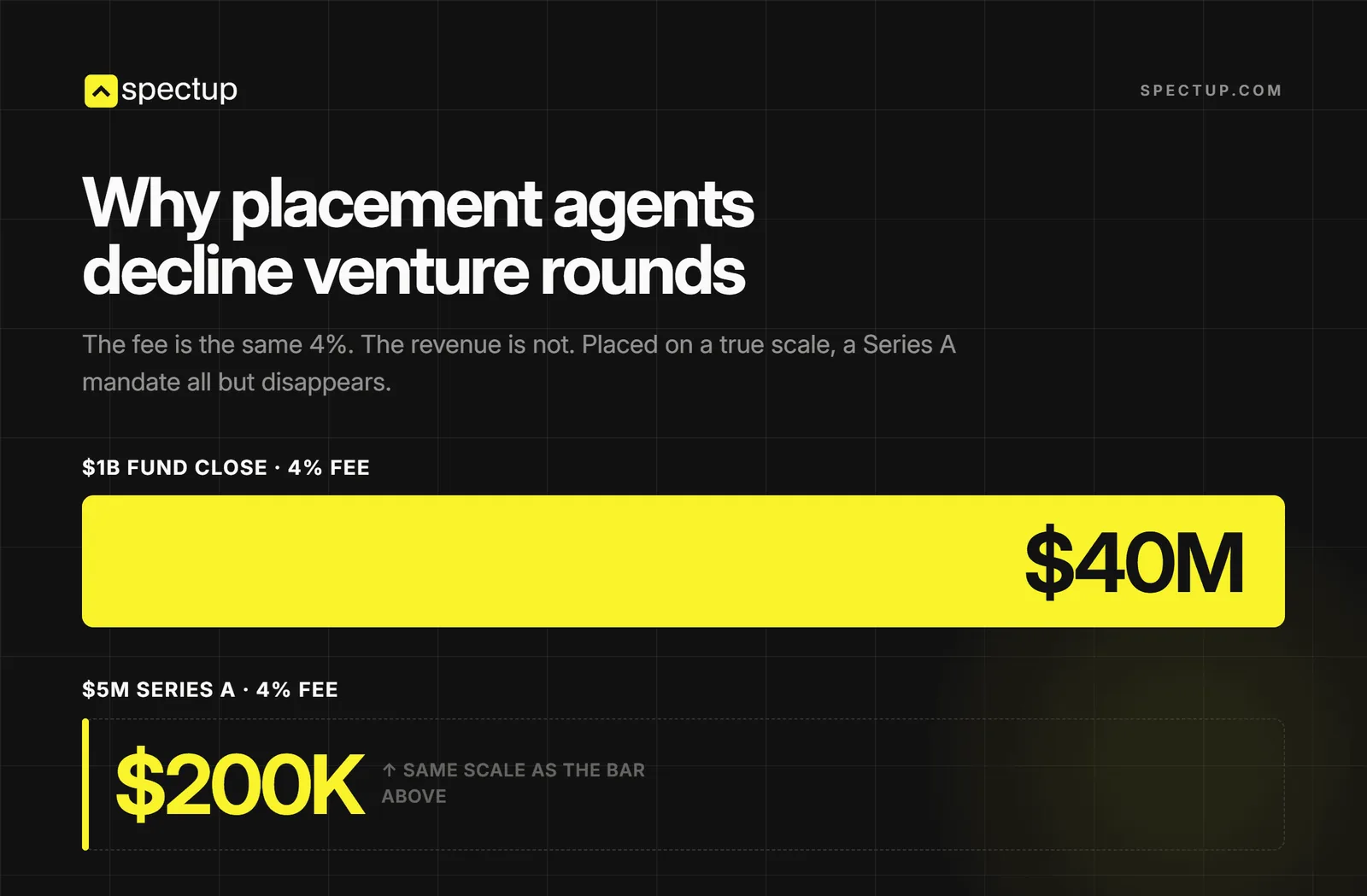
A traditional placement-agent commission on a $1B fund close at 4 percent is $40M of revenue
It fully funds the institutional infrastructure the agent runs: senior partner LP coverage, dedicated sector teams, multi-year fund-marketing cycles, compliance overhead, broker-dealer reporting. The same 4 percent applied to a $5M Series A is $200K, which doesn't pay for a single full-time partner for a quarter.
That math is why placement agents structurally avoid venture-round mandates. It's also why most companies don't get past an initial intake call when they reach out to a placement agent for a Series A. The conversation usually ends with a polite redirect to a fundraising consultant or to running the raise solo with help from a deck consultant. The spectup resource hub on fundraising consultants covers the alternative shortlist in depth.
Below is the rough cost-per-outcome math across the categories for a hypothetical $5M Series A raise. Numbers are approximations to illustrate the structural pattern, not quotes from any specific firm.
| Category | Typical Cost | What You Get | Right Fit For |
|---|---|---|---|
| spectup (company-side consulting) | $3K/mo retainer + 3.5% success on close ($175K all-in on $5M) | Deck, model, data room, outreach, term-sheet support | $2M to $25M venture rounds |
| Institutional placement agent | 4 to 7% success ($200K to $350K on $5M, but firms decline below institutional size) | LP coverage for fund GPs, not VC outreach | $250M+ institutional fund placements |
| Hourly freelance consultant | $150 to $400/hr ($30K to $80K typical) | One narrow workstream (model, deck, or outreach only) | Companies with bandwidth to run the raise themselves |
| Pitch deck consultant only | $5K to $25K flat | Deck refresh, no model, no outreach, no close | Companies with strong investor relationships already |
The structural takeaway is simple. A placement-agent commission was never designed for a venture round. If a small "placement agent" pitches you a 5 percent success-fee deal on a Series A, ask whether they're a registered broker-dealer (FINRA BrokerCheck is the public record) and ask what their last three closed mandates actually were.
The clearest way to feel the difference between these categories is to watch what happens when buyers mismatch them in practice. Three stories from the last 12 months of intake calls, anonymized and lightly composited to protect specific deal terms.

Anna runs a Series B biotech out of Munich with EUR 15M of target raise on the table and roughly EUR 18M in committed funding from prior rounds. She heard the phrase placement agent at a conference, Googled best private placement agency, and ended up on the website of a mid-tier institutional placement franchise. Three weeks of email back-and-forth followed.
The placement-agent intake partner was polite. He told Anna the firm normally needs a $250M+ mandate to take on a new client, that biotech wasn't a core sector for the practice, and that even if they were interested the commission economics on EUR 15M wouldn't justify the institutional staffing they would need to put behind it. The whole conversation was a category mismatch from the first email.
Anna's actual bottleneck was that she needed warm introductions to four named European life-sciences VCs, a sharpened scientific-narrative version of her deck, and three weeks of dedicated outreach prep before her next round of pitches. None of that required a registered broker-dealer. All of it required a company-side consultant with sector reach.
She closed the round eight months later with a different fundraising partner. The lesson she came back to share is that the category research at the top of her process cost her six weeks she didn't need to spend, and the structural mismatch was visible on day one if anyone in her network had told her that placement agent means institutional LP commitments in industry usage.
Ravi runs a US-based fintech raising a $4M seed extension. His prior round closed in 2024 with a generalist consultant who delivered a deck and walked away. For the extension he wanted someone closer to the round close and started by reaching out to two NYC firms that called themselves private placement consultants in their LinkedIn descriptions.
The first firm turned out to be a one-person shop running a commission-only structure: 6 percent of capital raised, no retainer, no clear scope of work between intro and close. The second firm was a registered broker-dealer that runs Reg D private placements for real estate sponsors, with a $50M floor. Neither was the right shape.
Ravi landed on a spectup intake call after his prior consultant referred him over. The first 20 minutes were spent walking him through the category map: placement agents serve fund managers, company-side consultants serve operating companies, and the commission-only pitch he had received from the NYC one-person shop is structurally misaligned because there is no shared cost when the deal stalls.
He left the call without signing a contract that day, sat with the category framework for two weeks, and came back to sign a standard retainer-plus-success engagement after the framework matched his own diligence on the two other firms. He's now mid-mandate with a Q3 close target on the $4M extension. The course-correction cost him nothing except clarity.
Sofia runs a B2B SaaS company in the Series A phase, $12M target raise, $1.8M ARR running into the conversation. She had two offers on her desk by the time she reached us. The first was a small Chicago-based outfit pitching a "placement agent for companies" service at 5 percent success only, no retainer, with a vague scope memo. The second was a senior-led fundraising consultant on a retainer-plus-success structure with a clear 12-week active outreach window.
Her diligence on the first offer started with the regulatory check. The Chicago firm was not on FINRA BrokerCheck as a registered broker-dealer, which meant the 5 percent commission structure they were pitching was probably in regulatory gray territory for a venture equity round. SIFMA's guidance on securities broker registration is the canonical reference for what crosses the broker-dealer line, and a private-placement-style commission on equity does cross it.
The second offer was structurally cleaner. Retainer of $3K monthly, 3.5 percent success on close, senior partner named in the contract, scope written out across deck, model, outreach, second-meeting prep, and term-sheet negotiation. Pricing alignment was visible from the first paragraph.
Sofia signed the second offer, ran the mandate through a 14-week active outreach window using our investor outreach playbook, and closed the Series A inside the window with a tier-one lead and two strategic co-investors. The total cost-per-outcome on her raise came in below the 5 percent commission the first firm had offered, with structurally tighter alignment and senior delivery throughout. Her takeaway, in her own words: the company-side structure wasn't just cheaper, it was the only structure that actually fit a venture round.
Six questions filter category-mismatched firms out of the funnel before you waste a calendar quarter on the wrong intake process.
The right firm will answer all six cleanly in the first call. The wrong firm will dodge two or three of them, which is the signal that the engagement is going to drift and the wrong-product hire is about to land in your inbox as a draft engagement letter. Kauffman Foundation research on company decision patterns at fundraising milestones is consistent with the pattern: buyers that diagnose category and structure upfront close faster and on better terms than buyers that let an intake-call pitch frame the decision for them.
We don't compete with Park Hill on a $2B PE fund close. We don't compete with Lazard on GP-led secondaries. We're not registered as a broker-dealer and we don't run institutional LP outreach. spectup's fundraising consultant practice exists to fill the gap that opens up when company-side venture rounds don't fit placement-agent economics, which is most of the venture market.
The structural thesis underneath the firm is that venture fundraising deserves the same banker-grade discipline that institutional capital advisory has had for 50 years, just sized and priced for a $5M Series A instead of a $1B fund close. The 2,400+ active VC relationships in our investor book, the 80-signal investor-timing platform, the three-tier curated network (40 personal partner relationships plus opted-in warm investors plus signal-triggered cold), and the media engine (Deal Makers (and Fakers) podcast, Raise or Die newsletter) are the infrastructure that makes that thesis work for venture-stage rounds.
If your raise is institutional, hire a placement agent from the other five firms on this list. If your raise is a venture round between $2M and $25M, start a mandate with us by visiting our start a project page. Either way, the most expensive mistake is signing the wrong category, which is the trap the SERP itself sets for companies that don't already know which side of the table they're on.
If you're hiring a private placement agency in 2026, the loudest decision your peers make is the brand decision. The most expensive decision they make is the category decision. The two are connected because most companies compare brands inside a single category without first asking whether they're shopping in the right category at all.
The upstream question is the only one that matters. Are you a fund manager raising LP commitments, or are you an operating-company company raising a venture round? If you can answer cleanly, the firm choice falls out of it. If you can't, find someone who'll diagnose the category before they sell you a contract. BCG's publications on private capital infrastructure are a useful background read on how the institutional side actually works, and our comparison of pitch deck consultants covers the adjacent decision most companies run at the same time.

The team at spectup is in the lead when it comes to quality of output. They helped us shape the direction for internal funding efforts. We worked with other fundraising consultants on different ventures, but spectup’s fundraising advisory support has been by far the best choice.
$5MRaised in total
Asked on first calls about the firms named above.
A traditional private placement agency is usually a regulated intermediary for institutional fund commitments. For most venture-stage companies, a company-side fundraising consultant is a closer fit.
Institutional placement agents often price around a success fee on committed capital. For venture rounds, compare that with company-side retainers and success fees that are sized to the actual raise target.
Use a placement agent when you are running a regulated institutional private placement or fundraise. Use a fundraising consultant when you need positioning, materials, outreach, and close support for a venture round.
Many placement agents operate as registered broker-dealers. Companies should verify regulatory status through the appropriate public records and confirm that the mandate scope matches the transaction.
Often no. Below institutional mandate sizes, company-side fundraising consulting can be more aligned because the work centers on VC positioning, targeting, and execution rather than LP placement.
Each one ranks a different service category. All seven sit in the resource hub.