Seventeen investor databases and PitchBook alternatives; sixteen are ranked only in the job their own pages say they are built for, scored out of 100 on the checks that matter for that job. Turn a card for how the score is made.
01 · LP raise
Raising a fund from LPs
90Preqin, out of 100
→Score
01 · LP raise
For fund managers and placement agents who need to know which LPs commit to funds like theirs, and who to call.
Scored on four checks, weighted for this job out of 100: history 40, contacts 30, LP count 20, price 10. Preqin leads with 90, Dakota follows with 80.
90Preqin, out of 100
02 · Company round
Raising a company round
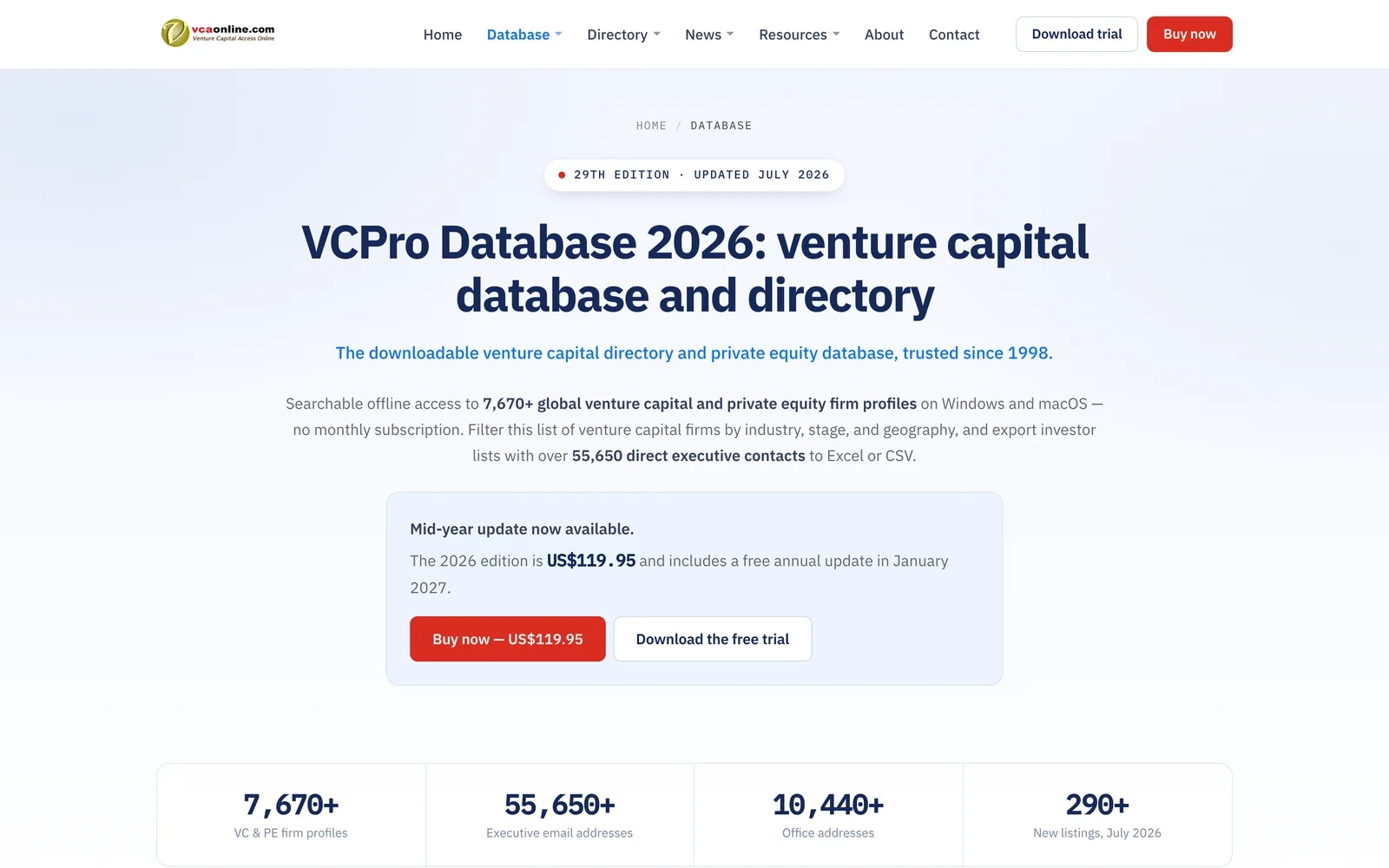
93VCPro Database, out of 100
→Score
02 · Company round
For founders and CFOs who need a list of investors that back their stage, sector and cheque size, with someone to write to.
Scored on four checks, weighted for this job out of 100: investor filters 35, contacts 30, price 20, history 15. VCPro Database leads with 93, Private Equity List follows with 85.
93VCPro Database, out of 100
03 · Deal sourcing
Sourcing deals and buyers
70Grata, out of 100
→Score
03 · Deal sourcing
For private equity, corporate development and M&A advisers who need private companies to buy, or buyers for a sale.
Scored on five checks, weighted for this job out of 100: financials 35, history 25, data source 15, contacts 15, price 10. Grata leads with 70, CB Insights follows with 55.
70Grata, out of 100
/ 02
The seventeen, sixteen of them ranked by job
Pick the job you are doing. Each table ranks the products built for it, out of 100.
For fund managers and placement agents who need to know which LPs commit to funds like theirs, and who to call.
8 columns. Drag the table sideways; the first column stays put.
Raising a fund from LPs, ranked out of 100
Provider
Best for
Pricing
History 40
Contacts 30
LP count 20
Price 10
Score
01PreqinLeads this job
Fund managers and placement agents researching LPs and their commitments
Sold by demo request; no price published
90/100
02Dakota
Fund managers raising from institutional allocators
USD 16,500 a year, plus USD 1,000 per extra user
80/100
03PitchBook
Teams that want a broad private-market dataset and can budget a quote
By request; varies by seats and firm type
60/100
04S&P Capital IQ Pro
Teams that already buy S&P data and want private markets next to public companies
Demo and access requests; no price
40/100
For founders and CFOs who need a list of investors that back their stage, sector and cheque size, with someone to write to.
8 columns. Drag the table sideways; the first column stays put.
Raising a company round, ranked out of 100
Provider
Best for
Pricing
Investor filters 35
Contacts 30
Price 20
History 15
Score
01VCPro DatabaseLeads this job
A one-off outreach list of venture capital and private equity firms
US$119.95 one-time, no subscription
93/100
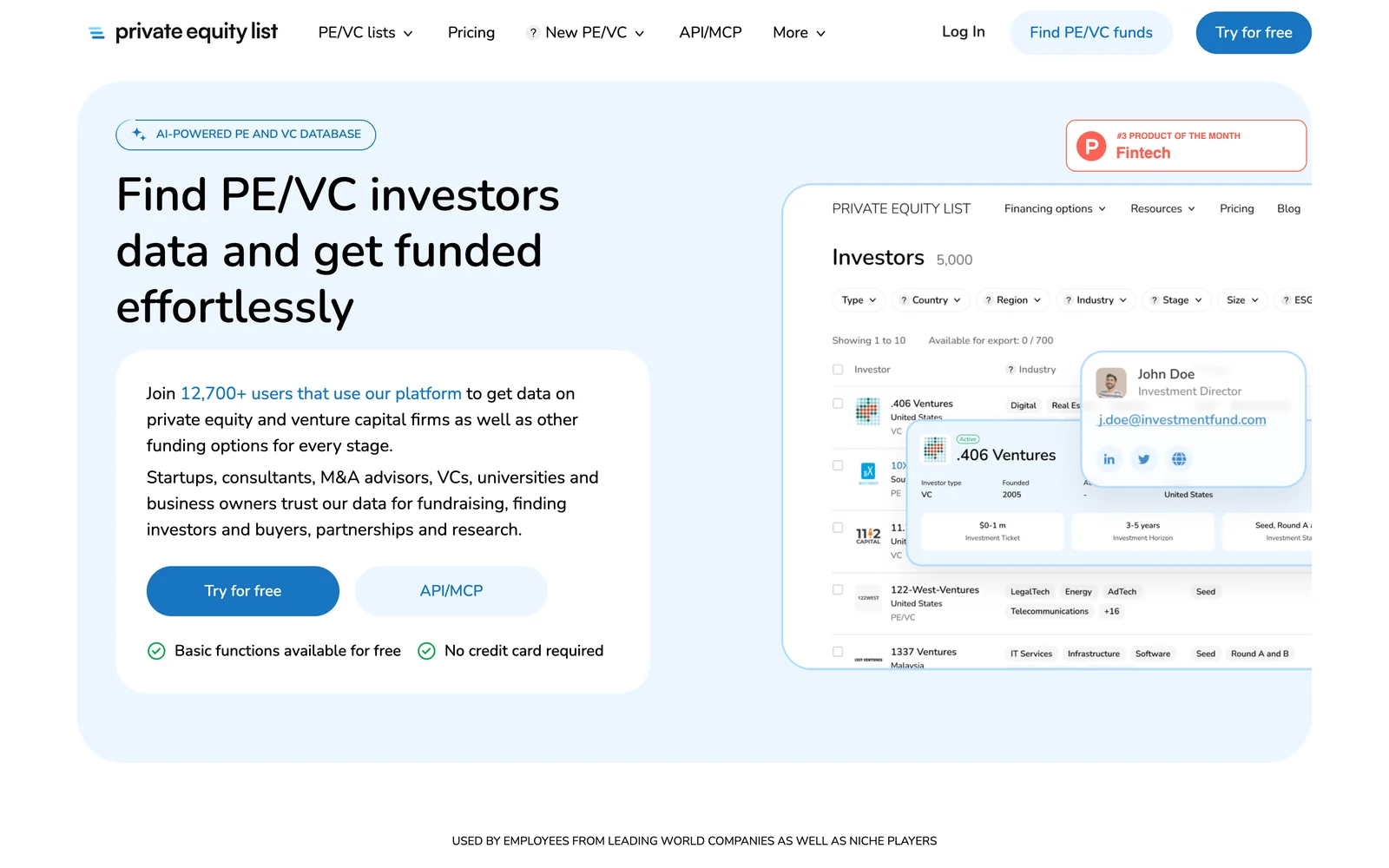
02Private Equity List
Advisers and companies that want PE and VC investor teams at a monthly price
Pro $129 a month; Pro Max $399 a month; Basic free
85/100
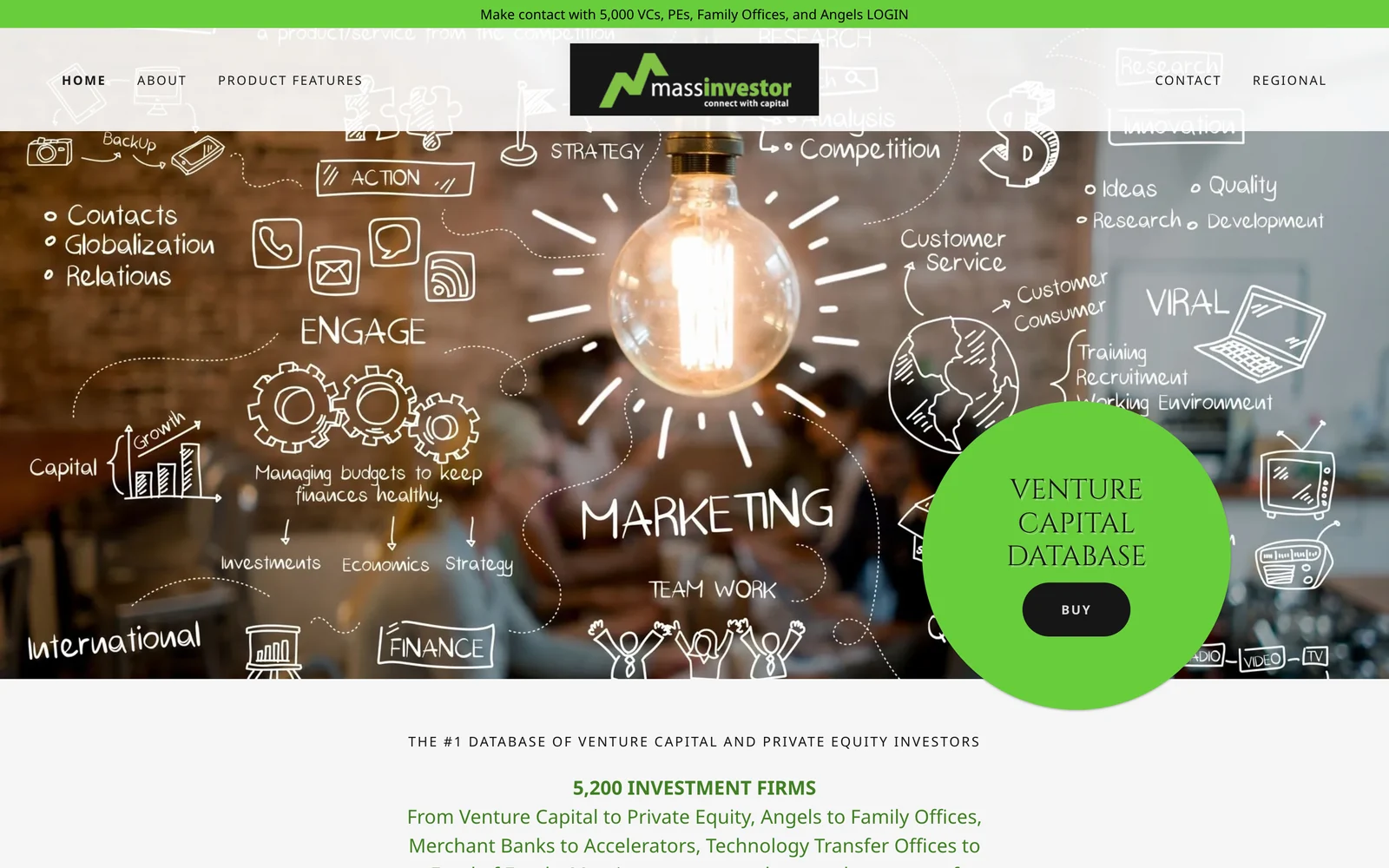
03Massinvestor
Small US outreach lists of venture capital and private equity partners
$895 for a one-year US subscription
75/100
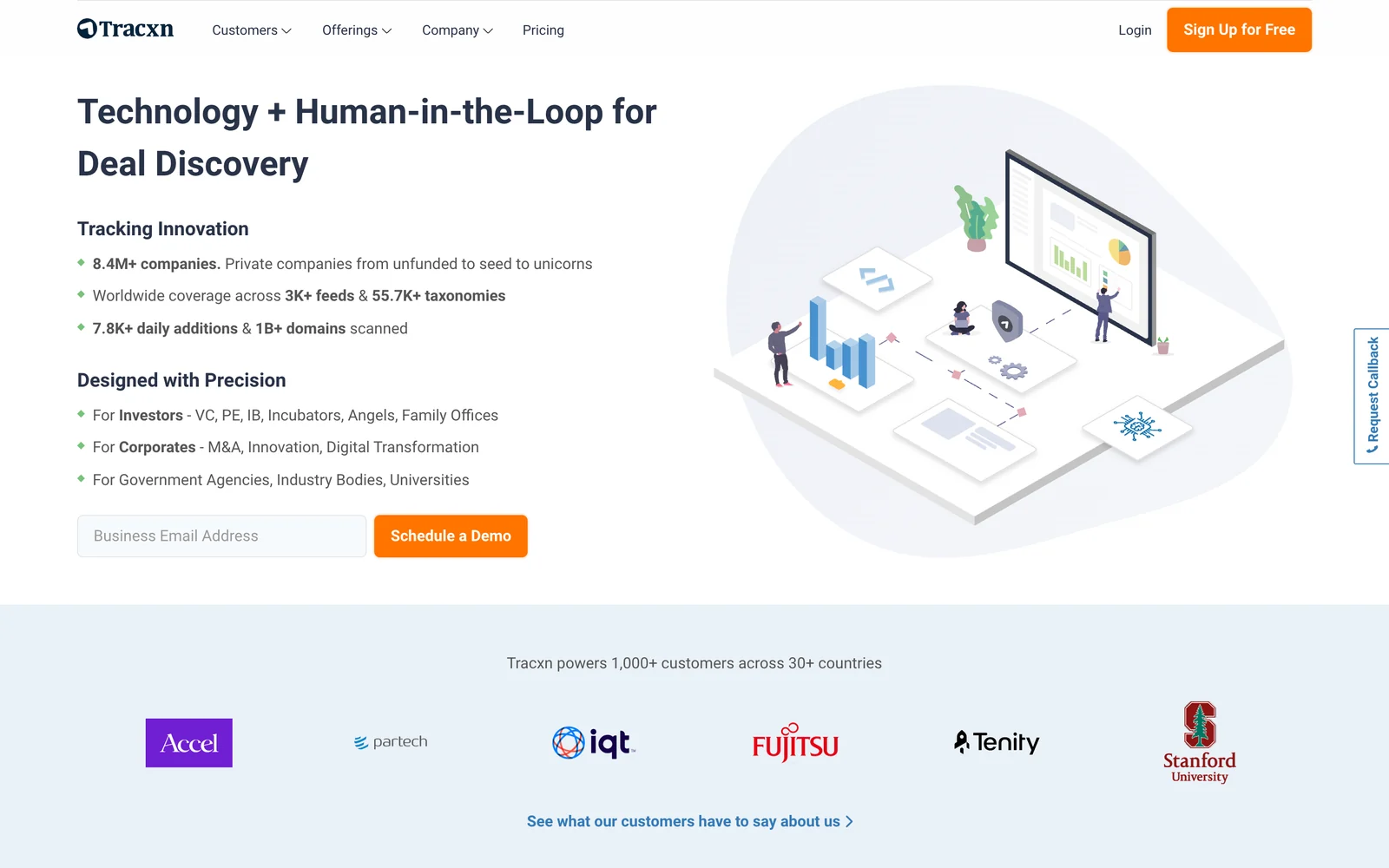
04Tracxn
Teams that want a free tier to screen investors and companies first
Free Lite plan; Premium by quote
73/100
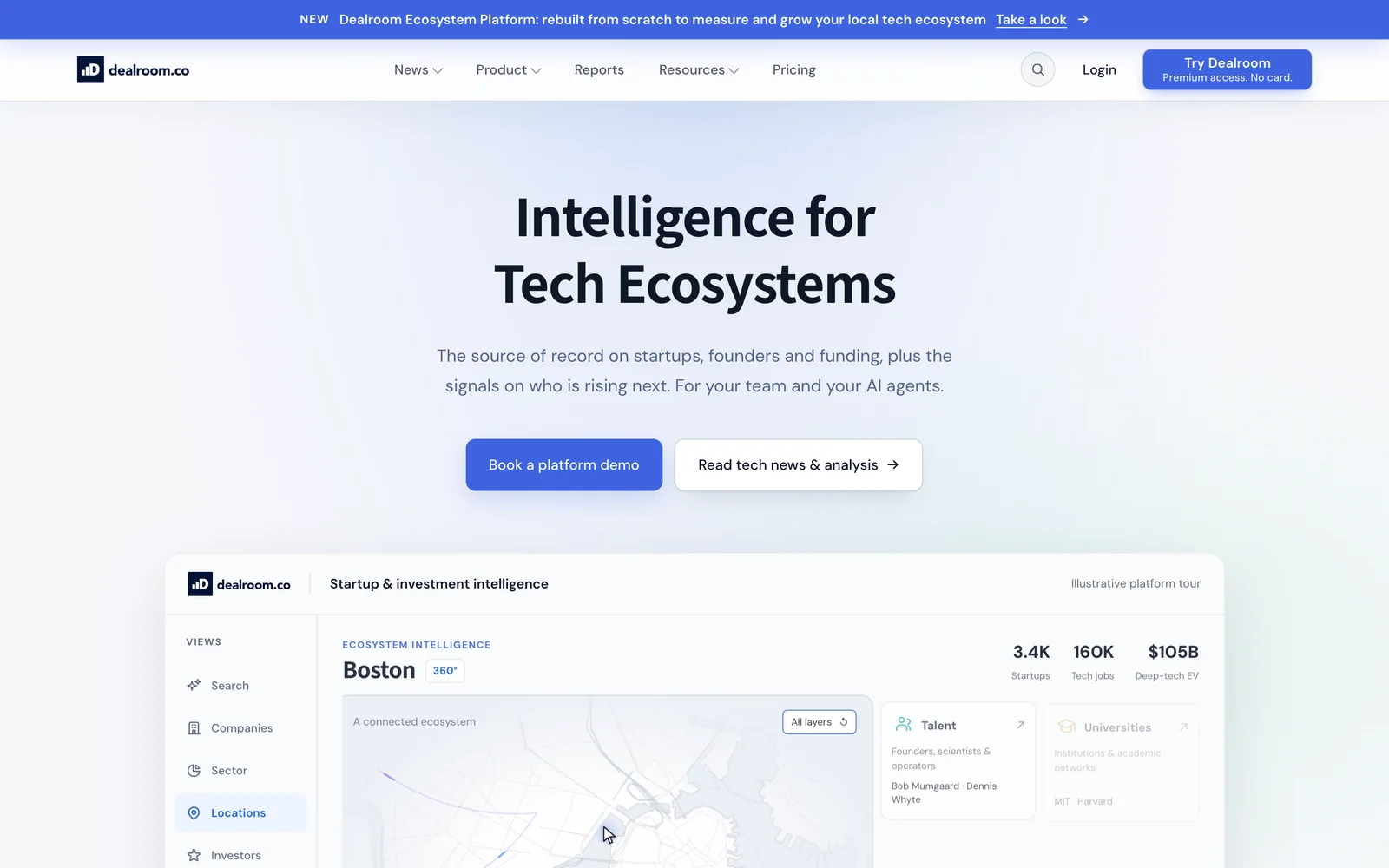
05Dealroom
European investor research by teams that want a printed per-seat price
EUR 250 per seat a month at 10 seats, billed annually, minimum 3 seats
63/100
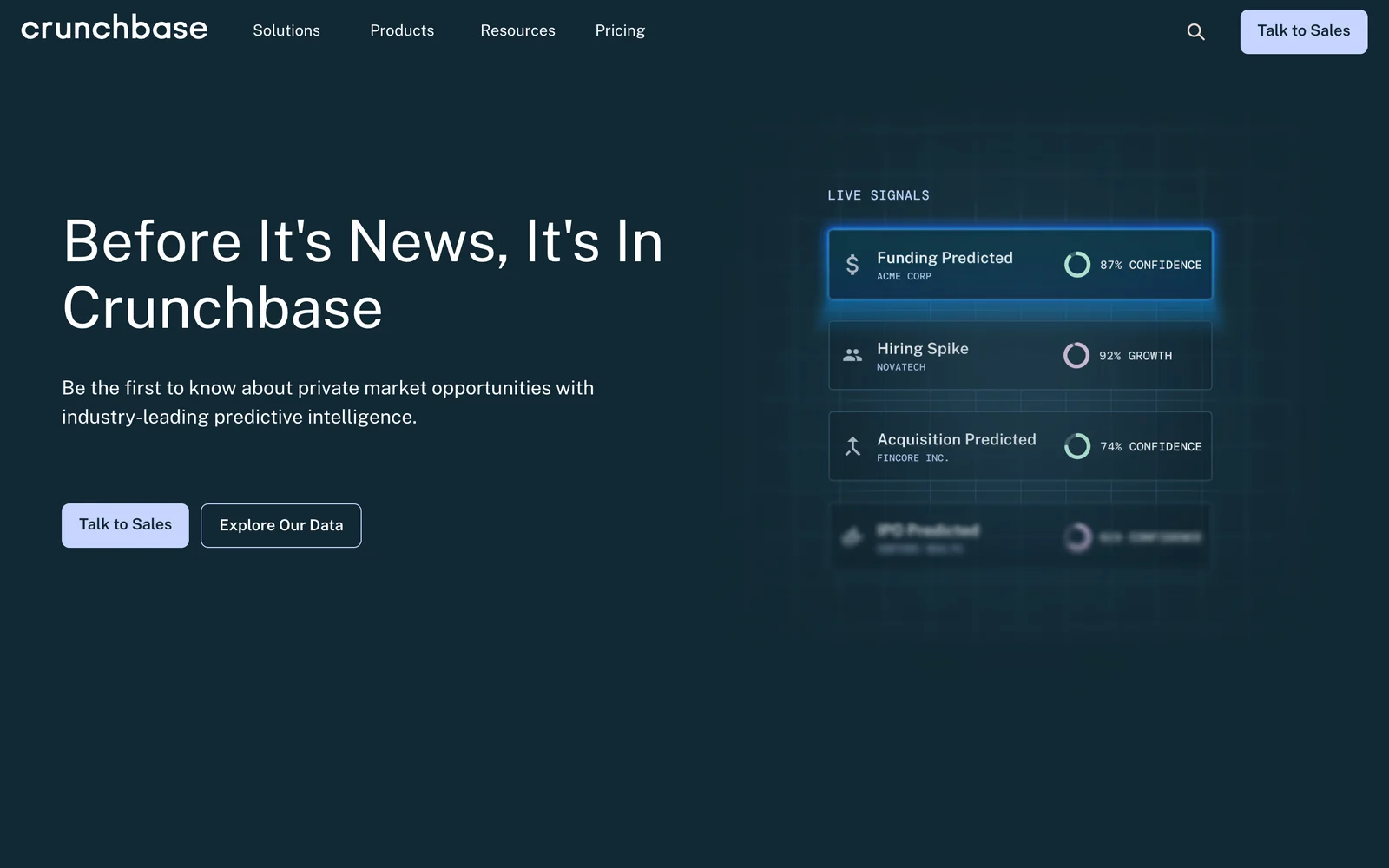
06Crunchbase
A first look at which investors back a sector or a stage
Pro $49 a month billed annually; Business from $199 a month
45/100
For private equity, corporate development and M&A advisers who need private companies to buy, or buyers for a sale.
9 columns. Drag the table sideways; the first column stays put.
Sourcing deals and buyers, ranked out of 100
Provider
Best for
Pricing
Financials 35
History 25
Data source 15
Contacts 15
Price 10
Score
01GrataLeads this job
Corporate development and advisers building buyer lists for a sale
Three packages, no price printed
70/100
02CB Insights
Strategy and corporate development teams that track private companies
By request only
55/100
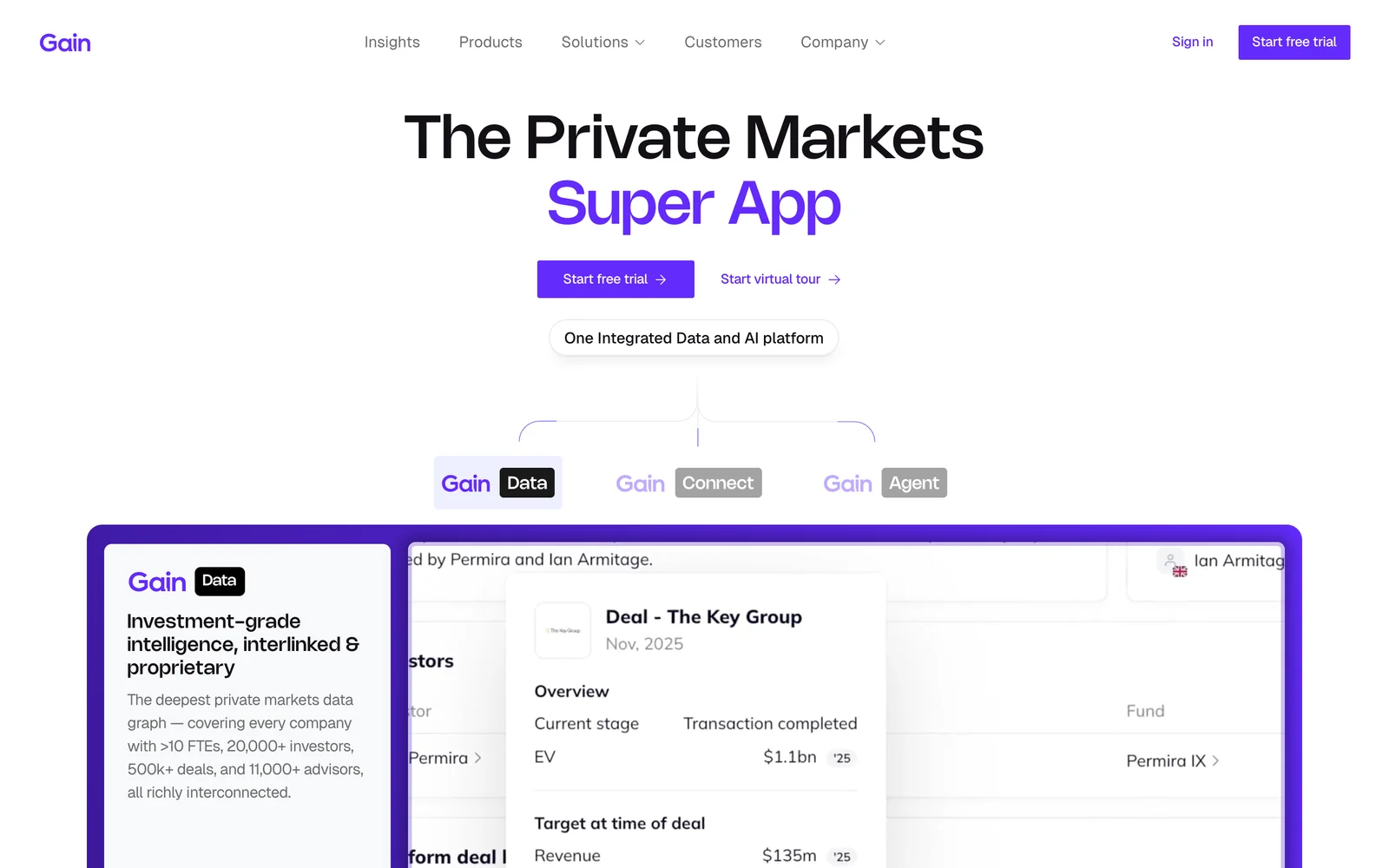
03Gain.pro
Private equity and M&A teams that want company, deal and investor data in one platform
By quote; free trial
55/100
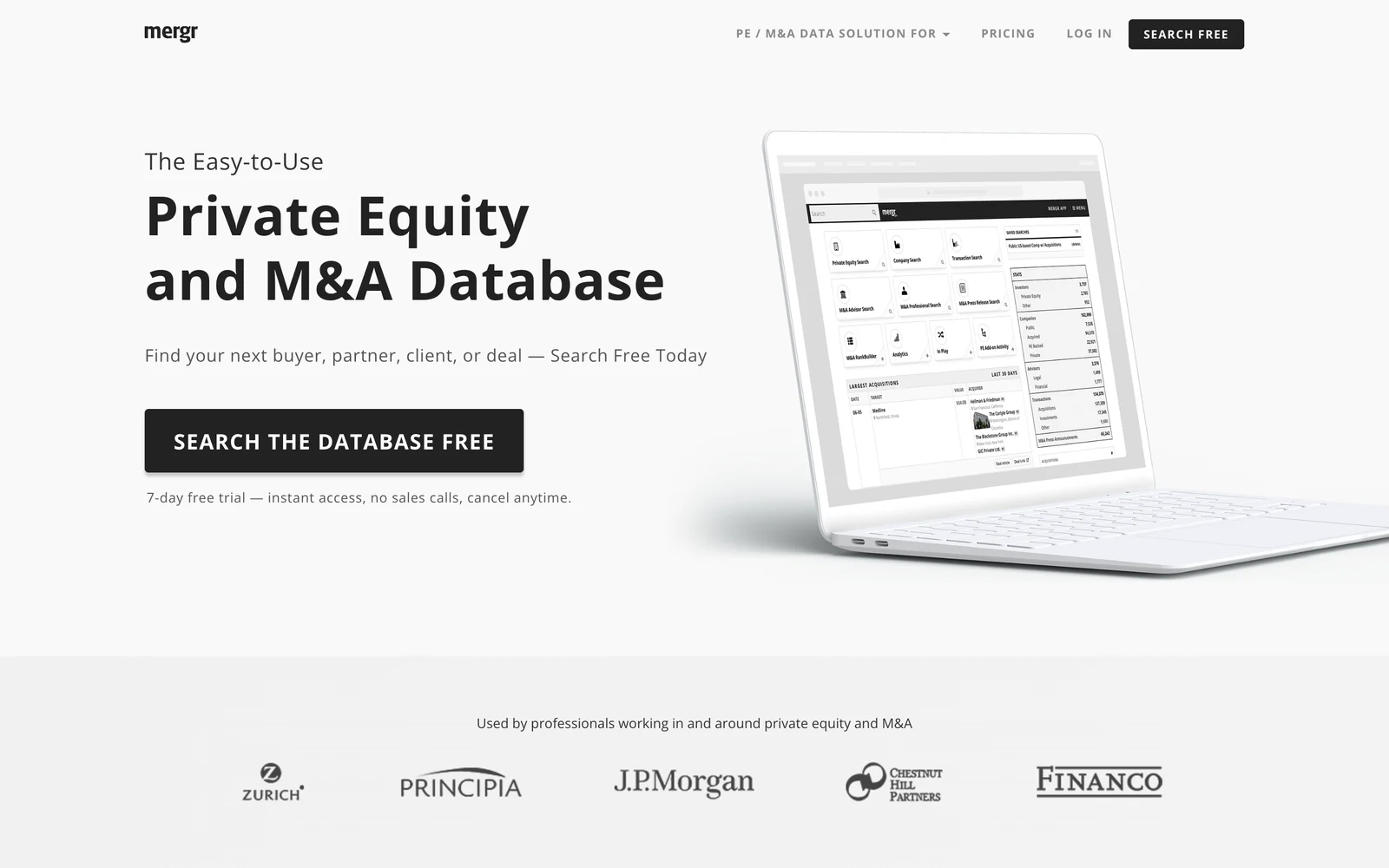
04Mergr
Corporate finance teams and advisers targeting private equity buyers
$150 a month, 7-day free trial
55/100
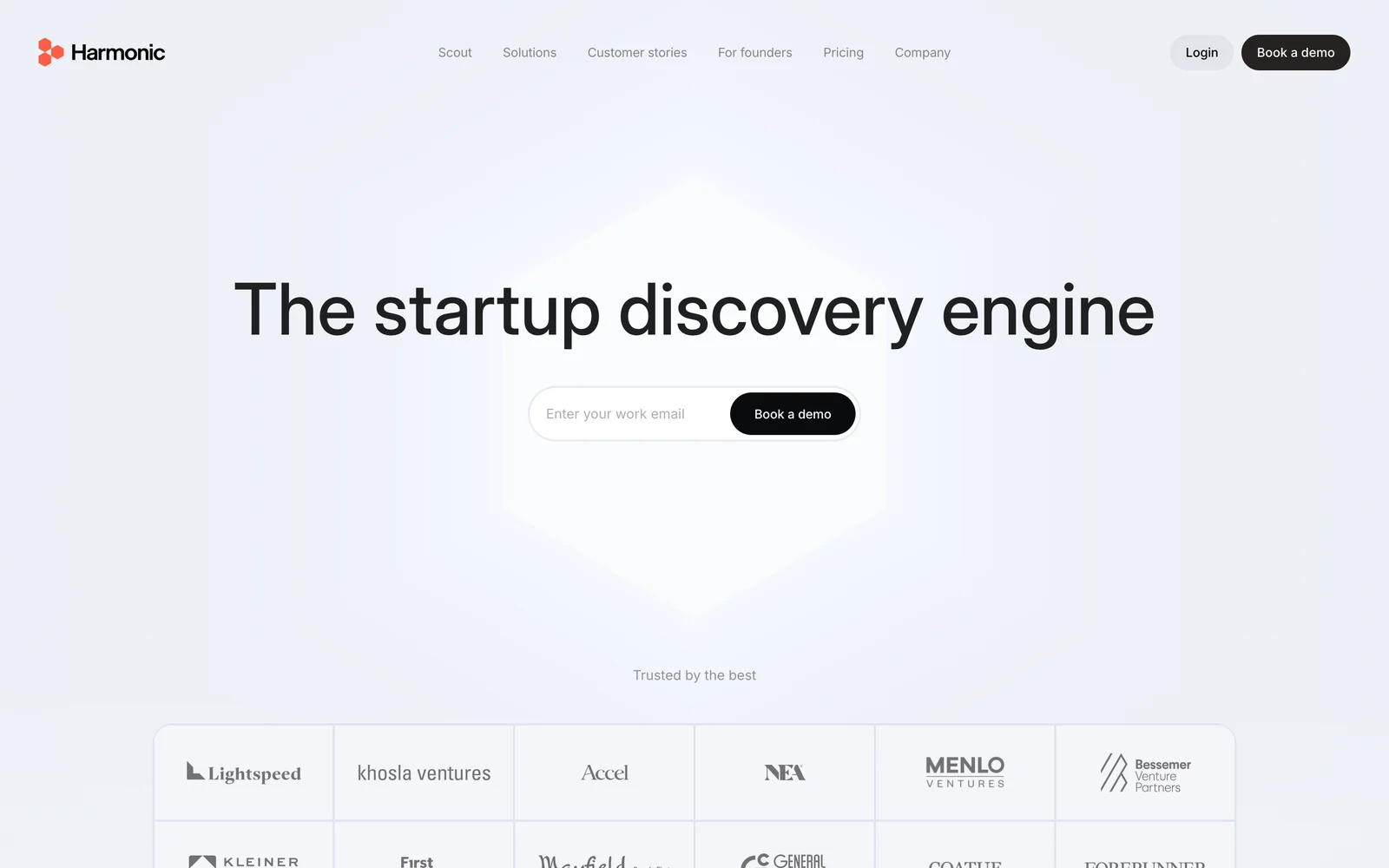
05Harmonic
Teams that track which investors show interest in private companies
Plans by request; no subscription price
38/100
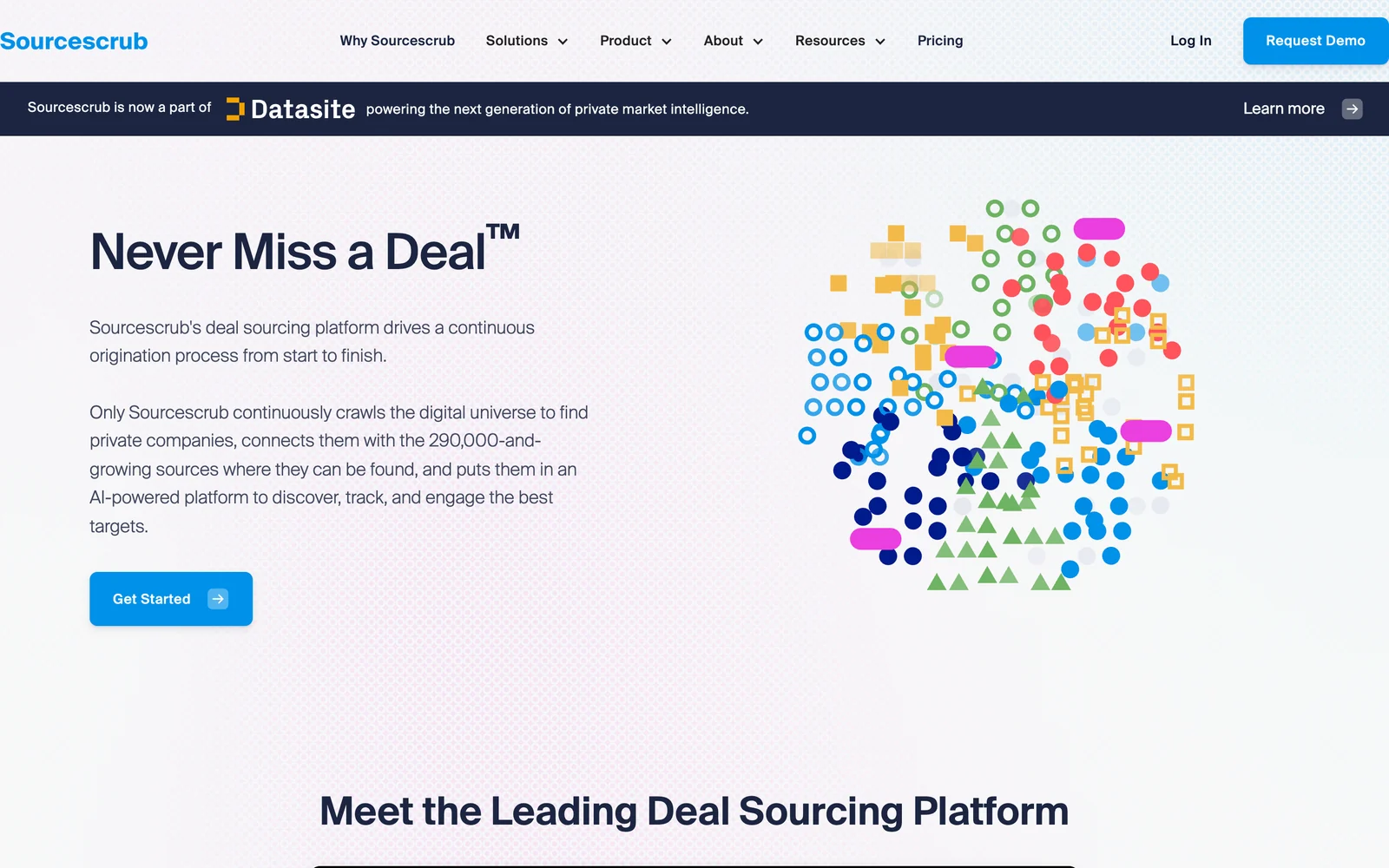
06Sourcescrub
Private equity sourcing teams that map companies
Every tier is Request pricing
30/100
Not rankedValicon, a data room with investor analytics: it supplies no investors to find or contact, which every job here needs, so its profile is below but it is ranked in no job.
Meets the checkHalf of a two-point checkNot found on its pagesScore out of 100: each check's points over its top mark, times the weight printed beside it, from each provider's own pages, as of 18 November 2026. Equal scores are listed alphabetically.
/ 03
How we compared
Seven checks carry points, each read on the products' own pages. A job weighs only the checks it needs; the bars show what each check is worth in each job, out of 100. The behaviour check is read too, but weighs in no job.
01
Shows investment history
Its own pages show which investments an investor made, and the top mark needs LP commitments or an investor's full investment history.
LP raise40Company round15Deal sourcing25
02
Names contacts at investors
Its own pages say it lists contact details, such as emails or phone numbers, for people at investors.
LP raise30Company round30Deal sourcing15
03
Prints a price
Its own pages print a price for the product: a subscription, a licence or a one-time price. A usage rate for one add-on feature does not count.
LP raise10Company round20Deal sourcing10
04
States where its data comes from
Its own pages say where its data comes from: supplied directly by investors, LPs, GPs or firms, or by its own users, instead of only public or third-party sources.
Deal sourcing15
05
States how many LPs it covers
Its own pages print a count of the limited partners, allocators or institutional investors its data covers.
LP raise20
06
Filters investors by stage, sector and cheque
Its own pages describe searching investors by investment stage, by sector and by cheque size; the top mark needs all three.
Company round35
07
Holds private company financials
Its own pages say it shows revenue, EBITDA or other financial figures for private companies; figures for only some of them, or headcount alone, score one.
Job by job, highest score first: four built for raising a fund from LPs, six for a company round and six for sourcing deals and buyers, then Valicon, a data room ranked in no job. Every figure on a card is the vendor's own.
01Preqin
LP databaseBlackRockLondon
A fund manager or placement agent that needs LP commitments to similar funds.
Preqin · preqin.com · 2 November 2026
Investors
20,000+
Funds
135,000+
Contacts
482,175
Strengths3
States LP commitments: investor profiles show past commitments to similar funds.
Counts only confirmed, active allocators as investors.
Offers an API and data feeds that can feed a CRM.
Considerations2
No price on its pages: Pro is sold by demo request.
Its pages describe no tracking of what investors do.
Verdict
Check the contact detail on your strategy in the demo; the product pages promise it in general terms.
02Dakota
LP databaseSubscriptionBryn Mawr
A fund manager that wants named allocators with direct contact details and a price it can read.
Dakota · dakota.com · 2 November 2026
LP accounts
250,000+
Verified contacts
386,000+
Marketplace, a year
USD 16,500
Strengths3
Prints direct phone numbers and verified emails for CIOs and allocators.
Alerts a team when an allocator launches an investment search.
Updated daily by its own research team, with CRM integrations and an API.
Considerations2
Does not state which LP committed to which fund.
Its fund counts differ by page: 57,000+, 18,500+, 17,100+ and 14,000+.
Verdict
Ask for the LP list in your strategy before you sign; USD 16,500 is the printed entry price for Marketplace.
03PitchBook
Market dataMorningstarSeattle
A team that needs broad coverage of investors, funds and deals in one product and will request a quote.
PitchBook · pitchbook.com · 2 November 2026
Investors
653,736
Companies
14,320,946
Deals
3,319,637
Strengths3
Counts 653,736 investors, 177,015 funds and 3,319,637 deals on its homepage.
States LP commitment and mandate data for fundraising.
Offers CRM integrations, an API and a data feed.
Considerations2
No price: its pricing page asks for a request, and CRM integrations are a premium addition.
States no direct email or phone for investor staff.
Verdict
Broad coverage across investors, companies, deals and funds; compare what you pay for on the points above.
04S&P Capital IQ Pro
Market dataS&P GlobalNew York
A team that already works in S&P data and wants private markets in the same place.
S&P Capital IQ Pro · spglobal.com · 2 November 2026
Private companies
60M+
PE and VC funds
110,000+
Rounds of funding
907,000+
Strengths3
Counts 110,000+ PE and VC funds and 907,000+ rounds of funding.
Connects investor commitments to fund performance and investor targeting.
Feeds data into workflows and Excel.
Considerations2
Its private markets coverage includes With Intelligence data, now available inside it, and its page prints no price.
S&P Global announced a strategic review of Capital IQ and associated data businesses on 27 October 2026.
Verdict
Suits a team that already works in S&P data; its private markets coverage sits inside the public markets platform.
05VCPro Database
VC and PE databaseOne-timeIn-house research
A one-off outreach list of venture capital and private equity firms at a one-time price.
VCPro Database · vcaonline.com · 2 November 2026
Firms
7,670+
Executive emails
55,650+
One-time
US$119.95
Strengths3
Prints a one-time price of US$119.95 with a free update at the next release.
Lists direct executive email addresses and titles.
Profiles show investment criteria and portfolio companies.
Considerations2
A file you run offline, updated twice a year in January and July, with no live updates.
No API or CRM integration, and the LP directory is a separate free list of 248 LPs.
Verdict
Fine for a single list: a file you run offline.
06Private Equity List
PE and VC databaseSubscriptionWyoming
An adviser or a company that wants PE and VC investor teams with contacts, at a monthly price.
Private Equity List · privateequitylist.com · 2 November 2026
Investors
8,150
Team contacts
57,268
Pro, a month
$129
Strengths3
Prints monthly plans from a free Basic tier to Pro Max at $399, and a $1,799 Lifetime Pro.
Lists investment-team contacts with roles and emails on Pro and above.
Offers a REST API, CSV export and an MCP connection, and says it is updated nearly every day.
Considerations2
States no LP commitments and no LP count; funds of funds and family offices are investor types to filter by.
Says coverage is partial by design, and that a material share of contacts have no email address.
Verdict
A low monthly price for PE and VC investor teams with contacts; check the email coverage on your strategy before you pay for Pro.
07Massinvestor
VC and PE databaseSubscriptionArlington
A small US raise that needs a flat-price list of venture capital and private equity partners.
Massinvestor · massinvestor.com · 2 November 2026
Firms
5,200
Partner emails
17,000
One year, US
$895
Strengths3
Prints a one-year price of $895 for the US database.
Profiles carry the email addresses of most partners.
States that firm profiles and financings are updated in real time.
Considerations2
No LP commitment data, no LP count and no API; it exports to Excel and PDF.
Publisher address is a PO Box in Arlington, Massachusetts; it began producing venture capital databases in 2002.
Verdict
A flat-price US list for a small outreach; it states no LP commitments and no API, so check coverage outside the US before you buy.
08Tracxn
Market dataFree tierBengaluru
A team that wants to screen investors for free before paying for a data platform.
Tracxn · tracxn.com · screenshot 2 November 2026, page read 16 November 2026
Investors
292K+
Companies
8.4M+
Lite plan
Free
Strengths3
Offers a free Lite plan.
Investor profiles show deal histories, co-investor networks and fund vehicles.
Integrates with Salesforce, HubSpot and Affinity, and documents an API.
Considerations2
Premium is by quote and no figure is printed.
No LP or allocator count and no LP commitment data.
Verdict
A free way to start; its investor profiles show deals, co-investors and partner contacts.
09Dealroom
Company databaseSubscriptionAmsterdam
A team that researches investors and rounds, especially in Europe, and wants a per-seat price.
Dealroom · dealroom.co · 2 November 2026
Companies
3.2M+
Funds
100K+
Premium, per seat a month at 10 seats
EUR 250
Strengths3
Prints per-seat prices: EUR 250 on Premium and EUR 325 on Premium Plus, at 10 seats.
Updates daily and offers an API with real-time sync.
Names Salesforce, HubSpot and Affinity for its API.
Considerations2
Prints no count of investors or LPs.
Its own guide says an LP-manager link does not establish an investment in a fund.
Verdict
Good for round and co-investor research; look elsewhere for LP commitments.
10Crunchbase
Company databaseSubscriptionSan Francisco
Someone who wants a low-cost first screen of investors by stage, sector and geography.
Crunchbase · about.crunchbase.com · 2 November 2026
Private companies
4M+
Verified updates a year
30M+
Pro, a month, billed annually
$49
Strengths3
Prints its plans: Pro at $49 a month billed annually and Business from $199 a month.
Shows funding history and investor data for each company.
Business adds CRM integrations; Pro exports up to 2,000 rows a month.
Considerations2
Prints no count of investors and states no LP commitments.
Its contact data covers people at companies.
Verdict
A low-priced start for screening investors; it does not state LP commitments.
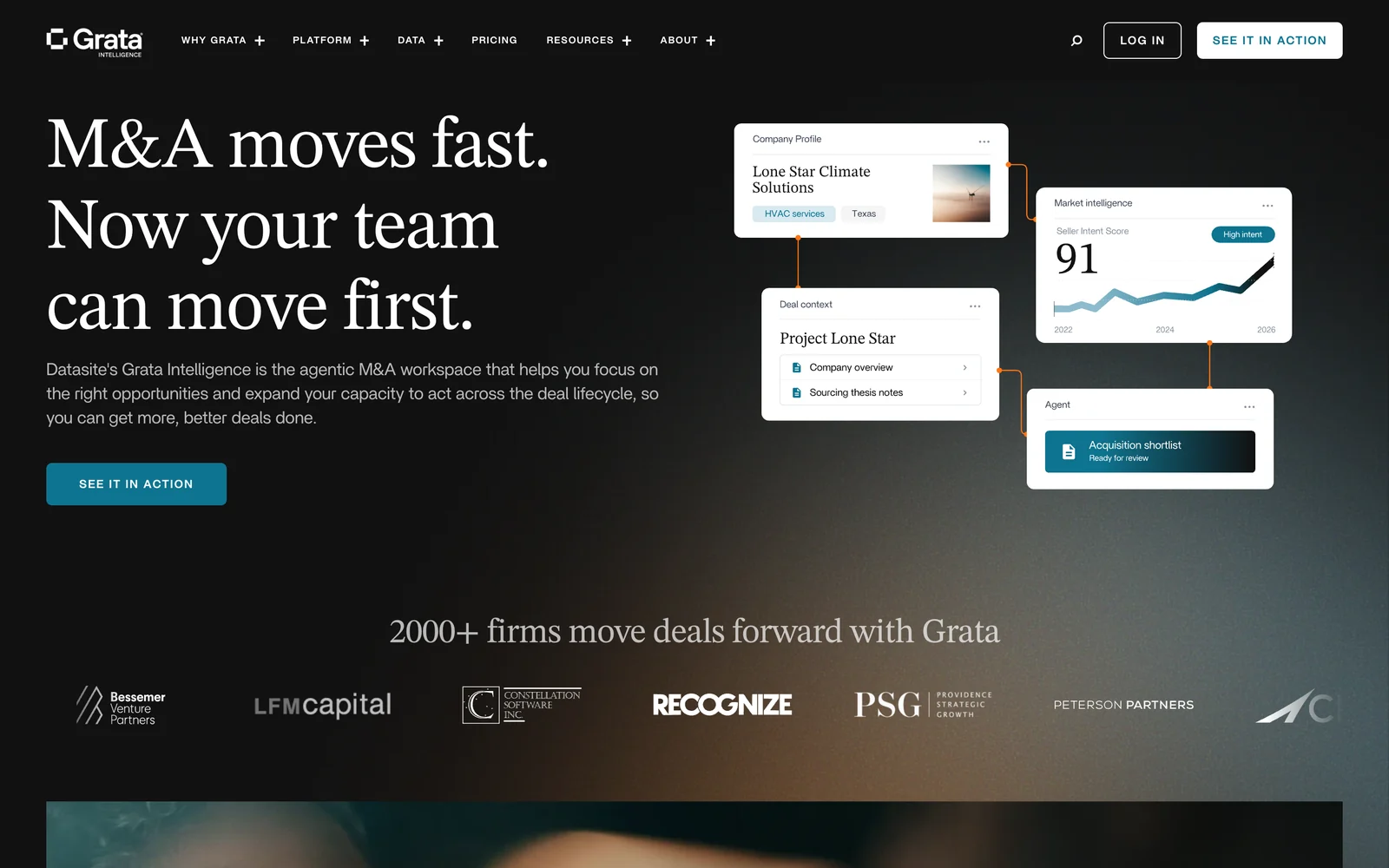
11Grata
Deal sourcingDatasiteNew York
An adviser or corporate development team that builds buyer lists for a sale.
Grata · grata.com · 2 November 2026
Companies mapped
22M+
Historical transactions
800K+
Financial sponsors
20,000
Strengths3
Searches investors by their past investments and ranks buyers by recency and frequency.
Pushes records into Salesforce, DealCloud, HubSpot or Affinity.
Documents an API and a weekly Seller Intent score.
Considerations2
Prints no price: its pricing page shows packages with demo buttons.
Prints 20,000 financial sponsors on one page and 100K+ on another; no LP count.
Verdict
Built for the sell side; ask whether the investor-discovery module fits a fund raise.
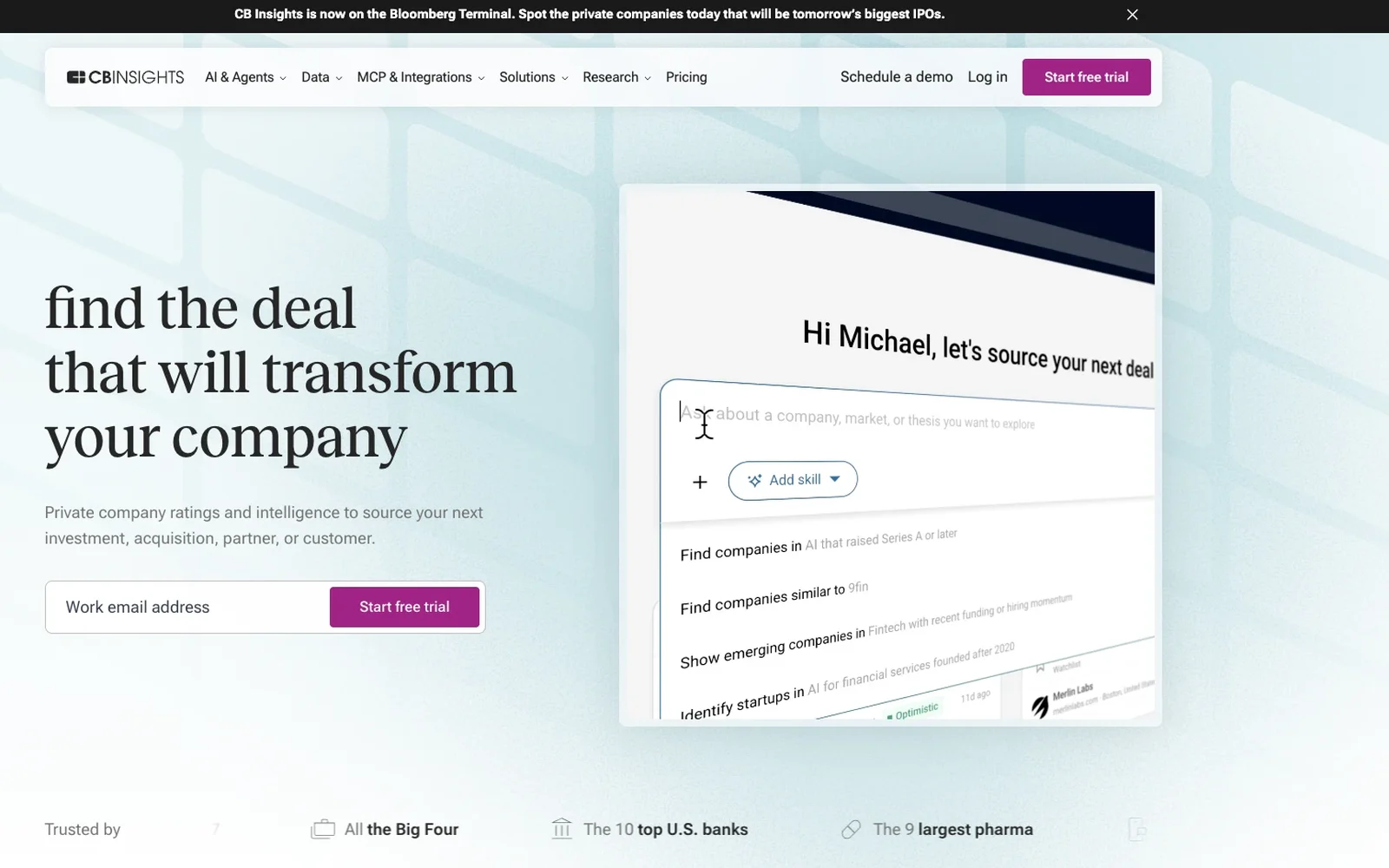
12CB Insights
Company intelligenceSubscriptionNew York
A strategy or corporate development team that follows private companies and their investors.
CB Insights · cbinsights.com · 2 November 2026
Company and investor profiles
13M
Deals traced
1.5 million
Pricing
Request
Strengths3
Traces 1.5 million deals with funding history for companies and investors.
Delivers through Salesforce, an API and data feeds to Snowflake, BigQuery and Databricks.
Continually refreshed and double-verified, by its own pages.
Considerations2
Pricing is by request only.
No LP or limited partner data on the pages read; its company totals read 12M+ and 13M+ on different pages.
Verdict
A company-intelligence product; it is not built for LP targeting.
13Gain.pro
Company databaseSubscriptionAmsterdam
A private equity or M&A team that wants companies, investors, deals and advisors in one platform with a CRM sync.
Gain.pro · gain.ai · 2 November 2026
Investors
20,000+
Deals
500k+
Advisors
11,000+
Strengths3
Counts 20,000+ investors, 500k+ deals and 11,000+ advisors on its product pages.
Syncs both ways with DealCloud and Salesforce, and offers an API feed, a bulk data feed and an MCP connection.
Lists allocators with fund-level tickets and aggregated capital allocation.
Considerations2
Prints no price: plans are quoted after a request, and a free trial is offered.
States no direct email or phone for investor staff, and prints no count of LPs or allocators.
Verdict
Strong where you start from companies and deals; ask what its allocator data holds for your strategy before you rely on it for LPs.
14Mergr
PE databaseSubscriptionFort Lauderdale
A corporate finance team or adviser that needs private equity buyers and their deal history at a printed monthly price.
Mergr · mergr.com · 2 November 2026
Private equity firms
4.9K+
Transactions
228K+
Pro, a month
$150
Strengths3
Prints a monthly price and a 7-day free trial.
Shows each private equity firm's current and former portfolio.
Pushes a record into HubSpot or Salesforce, and updates daily.
Considerations2
Covers private equity and M&A only: no venture capital firms or financings, and no LPs.
The API and bulk exports are licensed and quoted separately.
Verdict
Built for sell-side and buy-side targeting; it holds no LPs, so a fund raising from LPs looks elsewhere.
15Harmonic
Deal sourcingSubscriptionNew York
A team that follows investor interest in private companies and sources them.
Harmonic · harmonic.ai · 2 November 2026
Investors
250 thousand
Companies
40 million
Bulk data refresh
Weekly
Strengths3
Shows notable investor engagement with a company as an early interest signal.
Investor profiles show check sizes, recent deals and focus areas.
Delivers by API, Affinity, a CRM sync add-on, or in bulk via S3, BigQuery or Snowflake.
Considerations2
Plans are by request: no subscription price printed.
Its pages print three different company totals: 30M+, 35M+ and 40 million.
Verdict
Strong on company sourcing; its investor signal is interest in companies.
16Sourcescrub
Deal sourcingDatasiteSan Francisco
A private equity or advisory team that sources companies and wants the investors attached to them.
Sourcescrub · sourcescrub.com · 2 November 2026
Companies
17M
Sources
290,000
Fastest CRM sync
Daily
Strengths3
Native CRM integrations with bi-directional sync, as often as daily.
Delivers through an API and warehouse connections including Snowflake.
Shows the investors and funds associated with each company.
Considerations2
No price: every tier shows Request pricing.
Its own pages disagree on totals: 16M or 17M companies, 220,000 or 290,000 sources.
Verdict
A company-sourcing tool, now part of Datasite; the investor side is thin.
17Valicon
Data roomFree test accountApp offline
A company or fund that already has investors in a data room and wants to see how they read it, once the next version opens.
Valicon · valicon.ai · 16 November 2026
Price on its site
None
Test account
Free
Time to apply
2 min
Strengths3
Its pages describe every page-flip, dwell and re-open recorded per investor.
A free test account on application, with no card.
Says every deal room adds primary-source behaviour to its data.
Considerations3
Not available to buy today: its site only takes applications for a free test account, and its comparison page says it is offline while the next version is built.
Supplies no investors: it holds no investor or LP coverage and no investment history.
Prints no API or integrations on its public pages.
Verdict
Only worth an application if you want to read investors' behaviour in your own room later; it is not for sale today and does not give you investors to approach.
/ 05
The comparison in full
Seventeen investor databases are compared here, PitchBook and sixteen PitchBook alternatives, for fund managers, corporate finance teams and advisers who need data on investors, LPs and acquirers. Each product is ranked in the job its own pages say it is built for, out of 100. Preqin leads raising a fund from LPs with 90, VCPro Database leads a company round with 93, and Grata leads deal sourcing with 70.
VCPro Database leads the round on a low one-time price and named contacts; it is a downloadable list updated twice a year, not the broadest data. Valicon, a data room that supplies no investors, is described but ranked in no job.
The seventeen follow job by job, highest score first, each check taken from the product's own pages, read 2 Nov 2026 (Valicon and Tracxn, 16 Nov; Mergr, Private Equity List, PitchBook, Crunchbase and Gain.pro counts, 17 Nov). The three job checks were read on 17 Nov 2026.
Figure 01Preqin, VCPro Database and Grata lead their jobs with 90, 93 and 70 of 100Score out of 100 in the job each product is built for: raising a fund from LPs, a company round, or sourcing deals and buyers. Each check's points over its top mark, times the weight in the method. Equal scores are listed alphabetically; Valicon, a data room, is ranked in no job.
Figure 01 data: Preqin, VCPro Database and Grata lead their jobs with 90, 93 and 70 of 100
Item
Value
Preqin, LP raise
90 of 100
Dakota, LP raise
80 of 100
PitchBook, LP raise
60 of 100
S&P Capital IQ Pro, LP raise
40 of 100
VCPro Database, Company round
93 of 100
Private Equity List, Company round
85 of 100
Massinvestor, Company round
75 of 100
Tracxn, Company round
73 of 100
Dealroom, Company round
63 of 100
Crunchbase, Company round
45 of 100
Grata, Deal sourcing
70 of 100
CB Insights, Deal sourcing
55 of 100
Gain.pro, Deal sourcing
55 of 100
Mergr, Deal sourcing
55 of 100
Harmonic, Deal sourcing
38 of 100
Sourcescrub, Deal sourcing
30 of 100
Each product's own website, read 2 Nov 2026 (Valicon and Tracxn 16 Nov 2026, the three job checks 17 Nov 2026)
What do PitchBook alternatives sell?
A buyer comparing PitchBook alternatives for investor data meets four forms of product:
Private market data platforms, seven of them: CB Insights, Crunchbase, Dealroom, Gain.pro, PitchBook, S&P Capital IQ Pro and Tracxn. They hold companies, deals and investors in one product.
Investor and fund-manager databases, six: Dakota, Massinvestor, Mergr, Preqin, Private Equity List and VCPro Database. They hold investor firms and the people in them.
Deal sourcing platforms, three: Grata, Harmonic and Sourcescrub. They are built to find companies, with the investors attached. For the investor's side of that search, spectup runs deal origination.
A data room with investor analytics, one: Valicon. It supplies no investors. Its pages describe recording how the investors you already have read your documents, and today its site only takes applications for a free test account.
Figure 02Seven of the seventeen are private market data platforms and six are investor databases; three are deal sourcing tools and one is a data roomThe seventeen products on this page by what each one sells, as its own pages describe it, number of products
Figure 02 data: Seven of the seventeen are private market data platforms and six are investor databases; three are deal sourcing tools and one is a data room
Whole
Part
Share
Seventeen products
Private market data platforms
7
Seventeen products
Investor and fund-manager databases
6
Seventeen products
Deal sourcing platforms
3
Seventeen products
A data room with investor analytics
1
Each product's own website, read 2 Nov 2026 (Valicon and Tracxn, 16 Nov; Mergr, Private Equity List, PitchBook, Crunchbase and Gain.pro counts, 17 Nov)
Only three of the seventeen state limited partner commitments on their own pages: Preqin, PitchBook and S&P Capital IQ Pro. Coverage counts are printed on each card in the vendor's own unit, and aren't scored, because the units differ: investors, LPs, firms, funds, contacts or companies.
To have LPs and investors approached rather than searched for, spectup runs capital introduction services for companies and funds.
How we compared the seventeen investor databases
The seventeen are the products a fund manager, adviser or corporate finance team meets when it looks for PitchBook alternatives or an investor database. Each was checked on five things a buyer can confirm before a demo, and on one more for each job:
Every check is read on the product's own pages, before any demo.
Investment history: up to two points. One for deals, transactions or portfolios shown per investor, and a second for limited partner commitments, or an investor's full investment history with commitments, stated.
Contacts at investors: its own pages say it lists contact details, such as emails or phone numbers, for people at investors.
Investor behaviour: its own pages describe recording what investors do, such as the searches they run, the companies they show interest in or the pages they read. It matters because it tells you which investors are looking now.
A printed price: its own pages print a price for the product, such as a subscription, a licence or a one-time price. A usage rate for a single add-on feature doesn't count.
Data source: up to two points. One where its own pages say investors, LPs, GPs, firms or the product's own users also supply data directly, beside public sources, and a second where the data is generated by its own users' activity on the platform.
States how many LPs it covers: its own pages print a count of the limited partners, allocators or institutional investors its data covers.
Filters investors by stage, sector and cheque: its own pages describe searching investors by investment stage, by sector and by cheque size; the top mark needs all three. Up to two points.
Holds private company financials: its own pages say it shows revenue, EBITDA or other financial figures for private companies; figures for only some of them, or headcount alone, score one. Up to two points.
Each product is scored only for its own job, out of 100: each check's points over its top mark, times that job's weight. The weights were set before the three job checks were read:
4 columns. Drag the table sideways; the first column stays put.
Check
LP raise
Company round
Deal sourcing
History
40
15
25
Contacts
30
30
15
Price
10
20
10
Data source
0
0
15
LP count
20
0
0
Investor filters
0
35
0
Financials
0
0
35
Investor behaviour is read for every product and shown in the table below, but no job weighs it: the three jobs turn on who an investor is and how to reach them.
Delivery into your own systems, a CRM integration, an API or a data feed, was read for every product and is stated by fourteen of the seventeen, so it doesn't separate them and isn't scored. The three that state none are Massinvestor, VCPro Database and Valicon.
Only Valicon states that its dataset is the activity recorded in its own rooms; nine others state some first-hand data beside public sources.
A product that prints little can still be the right tool for your search, so read the scores as a measure of what you can confirm before the first call. They say nothing about how complete the data is. Marketplaces and lists of investors aren't here, because a buyer can't search, filter or export them as a product.
9 columns. Drag the table sideways; the first column stays put.
Product
Job
History
Contacts
Behaviour
Price
Data source
Job check
Score
Preqin
LP raise
2
1
0
0
1
1
90
Dakota
LP raise
1
1
1
1
0
1
80
PitchBook
LP raise
2
0
0
0
1
1
60
S&P Capital IQ Pro
LP raise
2
0
0
0
0
0
40
VCPro Database
Company round
1
1
0
1
1
2
93
Private Equity List
Company round
0
1
0
1
0
2
85
Massinvestor
Company round
1
1
0
1
0
1
75
Tracxn
Company round
1
1
0
0
0
2
73
Dealroom
Company round
1
0
0
1
1
2
63
Crunchbase
Company round
1
0
0
1
1
1
45
Grata
Deal sourcing
1
1
0
0
1
2
70
CB Insights
Deal sourcing
1
0
0
0
1
2
55
Gain.pro
Deal sourcing
1
0
0
0
1
2
55
Mergr
Deal sourcing
1
1
0
1
0
1
55
Harmonic
Deal sourcing
1
0
1
0
1
1
38
Sourcescrub
Deal sourcing
1
0
0
0
0
1
30
Valicon
Not ranked
0
0
1
0
2
none
not ranked
The job check is LP count for an LP raise, investor filters for a company round and financials for deal sourcing. Equal scores in a job are listed alphabetically, and no review score is used.
1. Preqin, LP commitments data, now part of BlackRock
Preqin says it was founded in 2003, and BlackRock completed its acquisition on 3 March 2025. Its own pages count 48,000 firms, 135,000+ funds and 20,000+ investors, where an investor means a confirmed, active allocator, and 482,175 key alternatives contacts.
It is one of two PitchBook alternatives, with S&P Capital IQ Pro, whose pages state LP commitments: investor profiles show past commitments to similar funds, and private equity investor data includes full investment history. Its source-new-business page lists contact details for key personnel and lead partners, and it offers an API and data feeds that can feed a CRM.
It prints no price and sells Pro by demo request. Its operating company is registered in England, with offices in London and 14 other cities.
Only Preqin, PitchBook and S&P Capital IQ Pro state limited partner commitments.
2. Dakota, the LP database with contacts and a price
Dakota sells Dakota Marketplace, a database of LP and allocator accounts with verified contacts. By its own count it holds 250,000+ LP accounts and 386,000+ verified contacts, and it prints direct phone numbers and verified emails for CIOs and allocators. Its pages say its research team reviews every record and that records are not self-reported, so it scores 0 on data source.
It prints its price: USD 16,500 a year plus USD 1,000 per additional user, and USD 9,500 a year for its Private Markets product. The data is updated daily, with CRM integrations and an API, and it alerts a team when an allocator launches a new investment search. Dakota was established in 2006 in Bryn Mawr, Pennsylvania.
It shows transactions mapped to the GP, fund and portfolio company, but its pages don't say which LP committed to which fund, and its fund counts differ by page.
Figure 03The ten sold on request score higher on history, behaviour and data source; the seven with a printed price name far more contactsShare of the points available on each check, %, for the ten products sold on request and the seven that print a price, from each product's own pages, 2 Nov 2026 (Valicon and Tracxn, 16 Nov 2026)
Figure 03 data: The ten sold on request score higher on history, behaviour and data source; the seven with a printed price name far more contacts
Scenario
Sold on request (10)
Print a price (7)
Gap
History
60
43
17
Contacts
30
71
41
Behaviour
20
14
6
Data source
40
21
19
Each product's own website, read 2 Nov 2026 (Valicon and Tracxn, 16 Nov; Mergr, Private Equity List, PitchBook, Crunchbase and Gain.pro counts, 17 Nov)
3. PitchBook, broad coverage, priced on request
PitchBook covers investors, companies, deals and funds in one product. Its homepage counts 653,736 investors, 14,320,946 companies, 3,319,637 deals and 177,015 funds, and its limited partners page covers LP commitments, mandates and strategies. Morningstar acquired it in late 2016, according to Morningstar's 10-K.
It offers CRM integration with Salesforce, Microsoft Dynamics or HubSpot, and a data feed and API, and its pricing page names both Direct Data and CRM Integration as premium offerings. The pricing page asks for a request and says pricing varies by seats and firm type.
It is ranked for an LP raise only: each product is ranked in one job, and its limited partners page is where it addresses one. Its company and deal data are not scored against the round and deal sourcing tools.
Its pages list people to contact but state no direct email or phone, and no tracking of investor behaviour, so it scores 60 of 100 for an LP raise.
Of the LP databases, only Dakota prints both a price and direct contacts for allocators. Seven of the seventeen print a price; ask the other ten for a quote in writing before the first demo.
4. S&P Capital IQ Pro, a public-markets platform with private-markets coverage
S&P Capital IQ Pro is the financial markets intelligence platform of S&P Global Market Intelligence. Its product page counts 60M+ private companies, 110,000+ PE and VC funds, and 907,000+ rounds of funding, and says private markets coverage now connects fundraising and investor commitments to fund performance and investor targeting.
Financial data feeds run into the user's workflows and Excel. The page offers access and demo requests and prints no price, and states no contacts at investors and no tracking of investor behaviour.
On 27 October 2026 S&P Global said in its third-quarter results that it had started a strategic review of alternatives, including a possible separation, for Capital IQ and associated data businesses. It gave no timeframe for the review.
Of the paid plans, VCPro Database costs least in a first year, US$119.95 once, and Dakota prints the highest flat yearly price, USD 16,500 before extra users.
5. VCPro Database, a downloadable list at a one-time price
VCPro Database is a product of Venture Capital Access Online. It is a downloadable VC database for Windows and macOS, searchable offline, that also covers private equity. By its own count it holds 7,670+ firm profiles and 55,650+ executive email addresses.
It costs US$119.95 one time with no subscription, and is updated twice a year, in January and July. It exports to Excel or CSV; no API or CRM integration was found. Profiles list investment criteria and portfolio companies.
A separate free directory lists 248 limited partners investing in VC funds. The research is done in-house by Access InterComm, and the first edition was published in 1998.
6. Private Equity List, PE and VC investor teams at a monthly price
Private Equity List is a database of private equity and venture capital investors and the people in their investment teams. By its own count it holds 8,150 investors in 119 countries and 917 cities, with 57,268 investment-team contacts, across seven investor types that include family offices and funds of funds. It says it is updated nearly every day.
Its pricing page prints Basic as free, with one page of results and no contacts, Pro at $129 a month, Pro+ at $249 and Pro Max at $399, and a one-time Lifetime Pro at $1,799. Contacts come with Pro and above, CSV export is capped at 300 a month on Pro+ and unlimited on Pro Max, and the REST API comes with Pro Max.
It states neither LP commitments nor a structured deal history, and lists each investor's funds and the portfolio companies some profiles name. Its own terms say coverage is partial by design and a material share of contacts have no email address. It is operated by PrivateEquityList LLC, a Wyoming limited liability company.
Private Equity List prints a free Basic plan; VCPro Database sells a one-time list with no subscription.
7. Massinvestor, a flat-price US list of venture and private equity partners
Massinvestor publishes a US VC database that also covers private equity. By its own count it covers 5,200 firms, with the email addresses of most partners, and a separate database of 1,000+ US single family offices. A one-year subscription to the US database costs $895.
Portfolio company records show transactions, deal size and investors, and the vendor says firm profiles and financings are updated in real time. It exports to Excel and PDF, and its Excel files can be imported into a CRM; no API was found.
It states no LP commitment data and no LP count. The publisher began producing venture capital databases in 2002 and lists a mailing address in Arlington, Massachusetts.
8. Tracxn, an investor database with a free tier
Tracxn is a private market data platform listed on the NSE and BSE since 20 October 2022, incorporated in 2012 and registered in Bengaluru. By its own count it tracks 8.4M+ companies and 292K+ investors, with a separate investor database page for 290K+ active investors including family offices, corporate VCs and angel networks.
Investor profiles show deal histories, co-investor networks and fund vehicles, and its profile page says you can find the right Partners and get in touch with decision-makers. Lite is free and Premium is by quote. It integrates with Salesforce, HubSpot and Affinity, and offers APIs, SFTP dumps, Snowflake and BigQuery.
Its pages print no LP count and no LP commitment data.
Two of the seventeen print a free tier: Tracxn's Lite plan and Private Equity List's Basic.
9. Dealroom, funding and investor data with per-seat prices
Dealroom was founded in Amsterdam in 2013. By its own count it tracks 3.2M+ companies and shows investor participation across 100K+ funds, with 336K+ VC rounds tracked since 2018. It prints per-seat prices: EUR 250 a month on Premium and EUR 325 on Premium Plus at 10 seats, billed annually; the rate per seat is higher on smaller teams, with a minimum of 3 seats.
Its data is updated daily, and it offers an API with real-time sync, with Salesforce, HubSpot and Affinity named for the API. Higher plans carry business email credits for outreach.
Its API data includes the limited partners behind funds, but its own build guide says an LP-manager link does not establish an investment in a specific fund, so this page scores its history at one.
Thirteen of the sixteen PitchBook alternatives state a CRM integration, an API or a data feed; Massinvestor, VCPro Database and Valicon don't.
10. Crunchbase, private company data with a low printed price
Crunchbase sells private company data. By its own count it covers 4M+ private companies and makes 30M+ verified data updates a year. Its pricing page prints Pro at $49 a month billed annually (listed at $79) or $99 billed monthly, and Business from $199 a month billed annually.
Each company profile shows funding history and investor data, and its investors page offers screening of investors by stage, sector and geography. Business adds CRM and workflow integrations, and the docs name a Salesforce managed package; Pro exports up to 2,000 rows a month.
Its pages print no count of investors or LPs and state no LP commitments, and its contact data is about people at companies.
11. Grata, buyer discovery inside a deal sourcing platform
Grata is a deal sourcing platform, and a Datasite company. Its investor-discovery module searches 20,000 financial sponsors and 100,000 strategic buyers by the keywords of their past investments, and ranks buyers by transaction recency and frequency. Elsewhere it maps 22M+ companies and 800K+ historical transactions.
It lists verified contact info for buyers, pushes records into Salesforce, DealCloud, HubSpot or Affinity, and documents an API. Its pricing page shows three packages with demo buttons and no price.
Its own page frames the module as buyer discovery for exits, and it prints 20,000 financial sponsors on one page and 100K+ on another.
Of the PitchBook alternatives here, Grata, Gain.pro and Sourcescrub are the ones to check first for buyers for a sale with a CRM push.
12. CB Insights, private company intelligence
CB Insights sells private company intelligence to source investments, acquisitions, partners or customers. By its own count it holds 13M company and investor profiles and has traced 1.5 million deals, and it shows funding history for companies and investors. The legal entity is CB Information Services, Inc., with a New York address.
It offers a Salesforce integration, an API, and data feeds to Snowflake, BigQuery and Databricks, and says its data is double-verified and continually refreshed. Pricing is by request only.
Its pages mention no LP or limited partner data, and its sourcing signals concern companies, such as rumored deals, so it is ranked for deal sourcing, where it scores 55 of 100.
13. Gain.pro, a company and deal platform with investor and allocator data
Gain.pro calls itself the Private Markets Super App, one platform for companies, investors, deals and advisors. By its own count it covers every company with more than 10 FTEs, 20,000+ investors, 500k+ deals and 11,000+ advisors.
Investor profiles show funds, strategies, deals and networks, and for allocators the page lists fund-level tickets and aggregated capital allocation. It doesn't use the phrase LP commitments and prints no LP count, so it scores one point for investment history, not two. Records sync both ways with DealCloud and Salesforce, and it offers an API feed, a bulk data feed and an MCP connection.
It prints no price: plans are quoted after a request, with a free trial. It states no direct email or phone for investor staff, and its alerts cover exits, fundraising and buyer moves, not what investors do. The legal entity is Gain.AI B.V. in Amsterdam.
14. Mergr, the private equity and M&A database with a monthly price
Mergr is a private equity database covering private equity firms, corporate acquirers, advisers and transactions, and nothing else. By its own count it holds 4.9K+ private equity firms, 228K+ transactions and 85K+ contacts. Mergr Pro costs $150 a month with a 7-day free trial, and the data is updated daily.
Mergr's own comparison with PitchBook says it has no LP filtering, so it suits a buyer search more than an LP raise.
Each private equity firm shows its current and former portfolio, and a record can be pushed to HubSpot or Salesforce. A REST API is licensed separately. Its help centre says it doesn't cover venture capital firms or financings, and its own comparison with PitchBook says there is no LP filtering.
It is based in Fort Lauderdale, Florida.
2 columns. Drag the table sideways; the first column stays put.
Product
The price its pages print
Dakota
USD 16,500 a year, plus USD 1,000 per extra user
Mergr
$150 a month for Pro
Crunchbase
$49 a month for Pro, billed annually
Dealroom
EUR 250 per seat a month at 10 seats, billed annually
Massinvestor
$895 for a one-year US database
VCPro Database
US$119.95, one time
Private Equity List
$129 a month for Pro
The other ten
No price for the product on the pages read
15. Harmonic, a discovery database with investor interest signals
Harmonic is a company discovery engine with investor profiles. Its pricing page counts 250 thousand investors, and the profile shows check sizes, recent deals and focus areas. Financing and investor data is sold as an add-on on its API and bulk plans.
Of the PitchBook alternatives, only three describe investor behaviour on their pages. At Harmonic, notable investor engagement with a company on X is an early interest signal, and its Hot 25 ranks companies on the aggregated interest of investors using the platform. Bulk data is refreshed weekly and delivered via S3, BigQuery or Snowflake, with an Affinity integration and an API.
Plans are by request, and the pages print three different company totals.
Figure 04Only Valicon's data, by its own description, comes from activity inside its own rooms; nine add first-hand data to public sources and seven state no first-hand dataThe seventeen products by what their own pages say about where the data comes from. First-hand means supplied directly by investors, LPs, GPs, firms or the product's own users
Figure 04 data: Only Valicon's data, by its own description, comes from activity inside its own rooms; nine add first-hand data to public sources and seven state no first-hand data
Group
Count
Of
Its own rooms only
1
17
Public sources plus first-hand data
9
17
No first-hand data stated
7
17
Each product's own website, read 2 Nov 2026 (Valicon and Tracxn, 16 Nov; Mergr, Private Equity List, PitchBook, Crunchbase and Gain.pro counts, 17 Nov)
16. Sourcescrub, company sourcing with investors attached
Sourcescrub is a sources-first private company deal sourcing platform, now part of Datasite. By its own count it holds 17M companies and 290,000 sources, and company profiles show the investors and funds associated with each company. Its San Francisco address is on every page.
Its native CRM integrations sync both ways as often as daily, and it offers an API and warehouse delivery. Every pricing tier reads Request pricing.
Its contact data covers executives at companies, and its investor data is attached to companies, so it is ranked for deal sourcing, where it scores 30 of 100. Its pages disagree on totals, giving 16M or 17M companies.
Three of the seventeen describe recording what investors do: Dakota, Harmonic and Valicon.
17. Valicon, a data room whose site now takes test-account applications
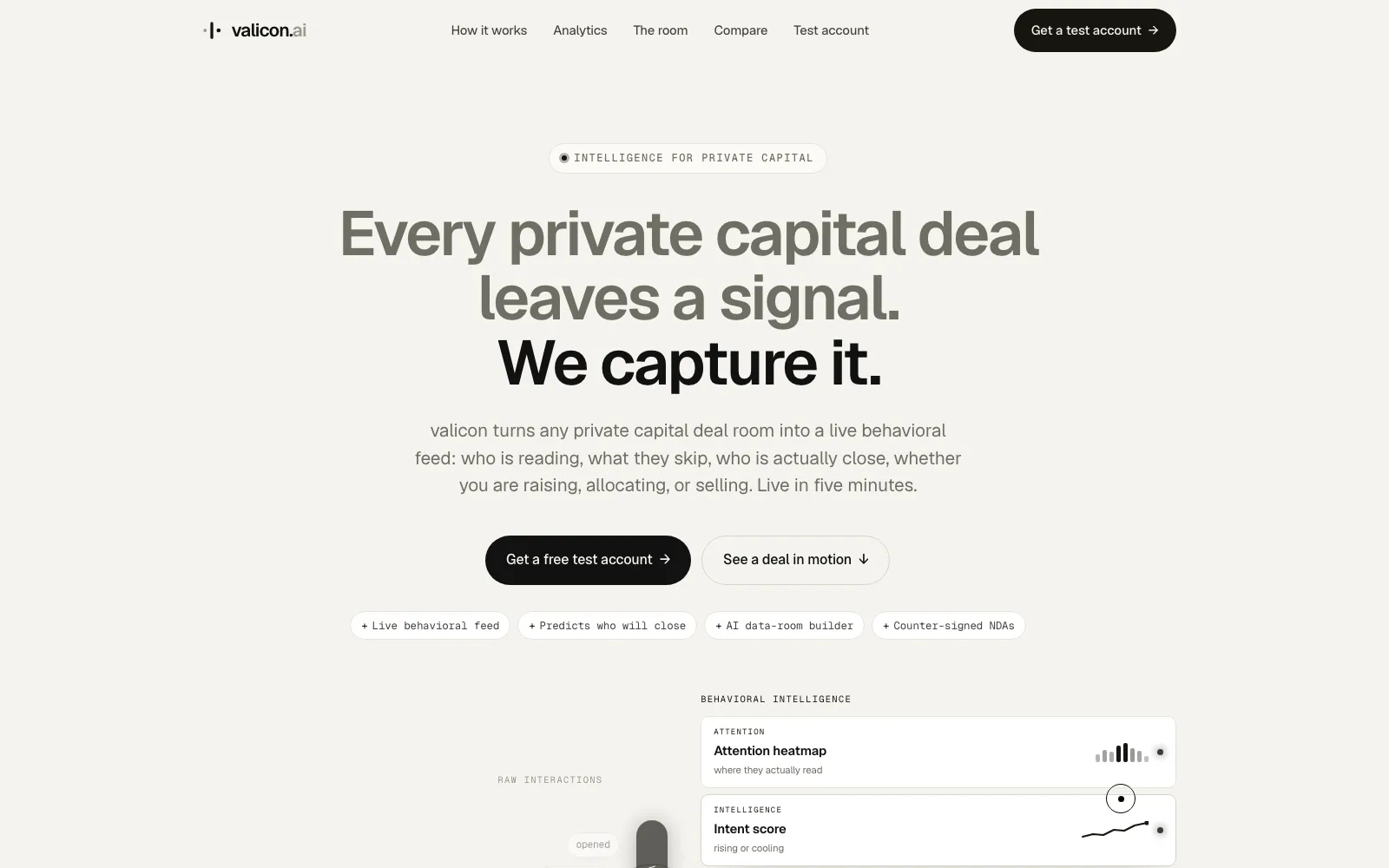
Valicon is a hosted data-room and investor-analytics platform, by its own terms. It is the odd one among the PitchBook alternatives here: it supplies no investors to approach and reports on the ones you already have. Its pages describe a behavioural feed on who is reading a deal room, what they skip and who is close.
Read again on 16 Nov 2026, its site no longer sells the product. The home page invites you to apply for a free test account and says it emails you when it is ready, and its comparison page says Valicon is offline for now while the next version is built. No plans page or sign-up is shown, and its terms name a Pro month price only in a referral clause, so the price check scores 0.
Its pages still describe that feed, with slide dwell and re-opens, so behaviour keeps its point. They still say every deal room adds primary-source behaviour, so the data is generated by its own users' activity, and it scores 2 on data source.
Its public pages print no investment history and no investor contacts it supplies, so those two checks score 0, and no coverage count, API or refresh frequency, which are not scored. It is ranked in no job here: every job needs investors to find or reach, and it supplies none.
Three of the seventeen describe tracking what investors do: Dakota, Harmonic and Valicon.
What should you ask before you buy one of the PitchBook alternatives?
01
Which investors in my strategy and region does the product hold, and how many have a direct contact?
02
Does it show which funds an investor committed to, or only that the investor exists?
03
How often is each record refreshed, and who verifies it?
04
Can the data reach our CRM or our own systems, and is that a premium addition?
05
What does it cost for the number of seats we need, and what does a renewal look like?
How spectup runs capital introduction for a company or a fund
spectup runs targeting, first contact, meeting preparation and the pipeline, and writes a 30-day update the client approves.
For a company or a fund, spectup runs the approach: targeting, the first contact, preparation for each meeting, the pipeline and an update every 30 days that spectup writes and the client approves.
It works five channels at once, because the channel an investor answers differs from one investor to the next.
The investor side is a network in three layers: 440+ relationships that came out of closed transactions, over 2,500 investors and LPs spectup has met in meetings with its clients, and the investor books of 30+ partner firms. The other four channels are spectup's technology, in-person dinners, an advisory network in markets it doesn't sit in, and its own media.
Fees follow the work: a monthly retainer while the outreach runs, then one success fee once the raise closes and the capital reaches the client. The success fee is a percentage of the capital raised, capped. The investor outreach guide shows what a campaign holds.
Which of the PitchBook alternatives fits your search?
2 columns. Drag the table sideways; the first column stays put.
If you need
Look first at
LP and allocator contacts with a price you can read
Dakota
A private equity database with buyers and their deal history
Mergr
LP commitments to similar funds
Preqin, PitchBook
Coverage of companies, deals, funds and investors in one product, priced on request
PitchBook
A low-cost first screen of investors by stage and sector
Crunchbase
A free tier to screen investors
Tracxn
European investors and rounds with per-seat prices
Dealroom
Buyers for a sale, with a CRM push
Grata, Gain.pro, Sourcescrub
Companies, deals and investors in one platform, with a CRM sync
Gain.pro
PE and VC investor teams on a monthly plan, with an API
Private Equity List
Interest in private companies
Harmonic
An investor database for a small list of venture capital firms at a low price
Massinvestor, VCPro Database
To see how investors read your own data room
Valicon (test-account applications only today)
If you would rather have investors approached than buy one of the PitchBook alternatives, the section above describes how spectup works, and the private placement agencies compared covers the firms that place funds.
Where you are22 sections
/ Answers
PitchBook alternatives: questions readers ask
8 questions on pitchbook alternatives, answered by Edwin Mik, Partner & Head of IR.
01How much does an investor database cost?
Seven of the seventeen print a price. Mergr Pro costs $150 a month, Crunchbase Pro $49 a month billed annually, Dealroom EUR 250 per seat a month at 10 seats, Dakota USD 16,500 a year, Massinvestor $895 for a one-year US database, VCPro Database US$119.95 once and Private Equity List Pro $129 a month. The other ten sell on request or by demo, and Valicon shows no price on its site today, only an application for a free test account.
02What is the best PitchBook alternative?
Dakota prints a price and direct contacts for allocators, Preqin states LP commitments as PitchBook does, and Mergr covers private equity buyers at $150 a month. For an LP raise Preqin scores highest here, 90 of 100; for a company round VCPro Database, 93; for sourcing deals Grata, 70. The scores rank what each product's own pages show, not how complete its data is.
03Which database suits a fund manager raising from LPs?
Dakota and Preqin are built around LPs. Dakota counts 250,000+ LP accounts and Preqin 20,000+ confirmed, active investors, so the two cannot be ranked on coverage. On this page's checks for an LP raise, Preqin scores 90 of 100 and Dakota 80.
04Do I need an investor database, or should I hire someone to approach investors?
A database gives you names and, at some vendors, contacts. spectup's capital introduction service runs the approach instead, paid by a retainer plus a success fee.
05Are there free investor databases?
Tracxn prints a free Lite plan and Private Equity List a free Basic tier with one page of results and no contacts. Mergr offers a 7-day free trial and Gain.pro a free trial. Valicon, which supplies no investors, only takes applications for a free test account today.
06Can an investor database feed my CRM?
Fourteen of the seventeen state a CRM integration, an API or a data feed. Massinvestor and VCPro Database export to Excel, and Valicon prints no API or integration on its public pages. A CRM integration is a premium addition at PitchBook and a Business-plan feature at Crunchbase, so ask each vendor whether it is in the plan you are quoted.
07Where does the data in an investor database come from?
Most describe public filings, news and websites. Nine state that investors, firms or users also supply data directly, and Valicon says its data comes from investors' activity in its data rooms, though its site only takes test-account applications today.
08Do investor databases show what an investor does with my deal?
Three describe some form of it, and only one inside your own data room: Valicon, a data room, says it records page-flips, dwell time and re-opens per investor inside your own data room, but today its site only takes applications for a free test account. Dakota alerts a team when an allocator launches an investment search and Harmonic shows investor engagement with companies.
Formerly at Barclays, Apax Partners and Euronext, Edwin knows how investors screen a raise. He works out who is allocating now, which of the 440+ relationships is the right first call, and what they need to see.